

Team coaching gets bought at a moment. A new leader inherits a team that does not yet trust them. Two companies merge and the combined leadership team is really two teams sharing a table. A group of capable people keeps missing the same handoffs and no one will say why in the room. You have the right individuals and the team still is not performing as a unit, and coaching each person separately has not fixed it.
That is the work team coaching does that one-to-one coaching cannot. It coaches the team as a single thing: how the group makes decisions, handles conflict, and holds each other to account. It is worth being clear that two different products both use the phrase. Team coaching works with an intact team on how it operates together. Group coaching puts a cohort of unrelated people through coaching together, mainly to reach more of them at a lower cost per head. Some providers do one, some do both.
We compare six team and group coaching services on seven criteria that decide which one fits your situation, from who actually runs the sessions to what you can point at when it is over. Here is how they compare.
| Criteria | LAK Group | Korn Ferry | Heidrick & Struggles | CCL | BetterUp | GrowthSpace |
|---|---|---|---|---|---|---|
| Who delivers the work | Practitioners who have held senior line roles, matched on fit | Coaches backed by proprietary assessment and research IP | Coaches, many former C-suite or functional leaders | Coaches from the top 3% of applicants, PhD or masters | 4,000+ platform coaches across 70+ countries | 2,800+ experts matched to a defined skill by AI |
| Adapted to the team or a standard program | Scoped to your team and its specific breakdown | Proprietary IP applied, often to a set format | Customized, with a team diagnostic up front | Research-based methods, largely set formats | Packaged products by population and goal | A development sprint scoped to a skill gap |
| Group size and format | Intact leadership teams, virtual and in person | Team and top-team formats, program-based | Intact top teams and boards, benchmarked | Team programs and open-enrollment cohorts | Large cohorts and group circles at scale | Cohorts by shared skill, sprint-based |
| What reinforces the work between sessions | ORIEL: AI practice partner, simulations, meeting feedback | Assessment tools and research brought into sessions | Technology-enabled, specifics not published | Coach contact plus resources on the platform | AI coaching inside the apps people already use | Tracked skill milestones across the sprint |
| Fit and cost for a mid-sized organization | Built for the mid-market, quote-based, no minimum | Contracting built around Fortune 1000 buyers | Premium positioning at C-suite and board level | Seats published, cost scales person by person | Enterprise volume pricing, 750+ enterprise clients | Volume pricing by sprint and population |
| How it connects to the rest of your talent strategy | One firm across assessment, coaching, development, succession | Coaching alongside search, assessment, and consulting | Coaching alongside search, assessment, and culture | Development and 360s, no search or hiring assessment | Coaching platform only, no assessment-for-hire | Skill development platform, no hiring or succession |
| How results are measured | Against engagement goals, no published metric | Aggregated assessment data, no published team metric | Publishes aligned teams outperform others by 23.5% | Publishes 97% great value, 94% performance improved | Publishes 14x average ROI and turnover reduction | Measurable outcomes tied to the defined skill gap |
Figures reflect what each provider published. Where pricing is not published it has to be requested, so confirm every number against your own quote.
What to look for in a team coaching service
Seven questions decide whether a team coaching engagement changes how your team works or just gives it a good offsite. Each one is worth asking before you sign.
- Who actually runs the sessions. Coaching a team is harder than coaching a person, because the coach has to hold a room where people outrank and depend on each other. Ask who will be in front of your team and what they have run. A coach who has led a team through the exact tension yours is under reads the room differently from one trained only in facilitation.
- Whether it adapts to your team or runs a set program. A merged team learning to trust each other and an intact team fixing broken handoffs need different work. Ask what changes between those two engagements. If the answer is the same framework with different exercises, you are buying a program rather than coaching built around what is actually breaking in your team.
- The group size and format. Team coaching for an intact leadership team and group coaching for a cohort of unrelated managers are different products with different aims. Ask which one you are being sold, how many people are in the room, and whether the sessions are live, virtual, or a mix. The format decides whether the work reaches the team as a unit or reaches individuals in a group.
- What reinforces the work between sessions. A team coaching offsite fades fast if nothing carries it into the weeks that follow. Ask what the team practices between sessions and how the coach stays close to real work, not just the next scheduled meeting. The change you are paying for happens in the ordinary meetings after the coach leaves the room.
- What it costs at your size. Premium firms price team coaching at the board level, and platforms price group coaching per seat. Ask for the all-in cost for your specific team, and whether the price is built for a Fortune 1000 top team or for a mid-sized leadership group. A firm built to coach a Fortune 1000 board is not automatically the right fit for a 12-person leadership team at a 400-person company.
- How it connects to the rest of your talent work. A team coach learns more about how your leaders operate together than almost anyone. If the same firm runs your assessments and succession, that insight can inform who leads which team next. If team coaching sits with a separate vendor, what surfaces usually stays in the room and never reaches those decisions.
- What gets measured. Ask what the provider will show you when the engagement ends. A better offsite and higher satisfaction tell you the sessions happened. Whether the team hits the goals it set, whether trust and alignment scores moved, and whether the handoffs that were failing now hold tell you the coaching worked. Decide which proof you need before the pitch.
The big firms win clearly on two of these seven: they publish outcome data behind team coaching, and they bring proprietary team diagnostics that benchmark your team against others before the work starts. Heidrick & Struggles publishes that aligned, trust-based teams with clear goals outperform others by 23.5%, and CCL and Korn Ferry bring decades of research to the table.
The list narrows on the other five, and especially on who runs the room and how far the work reaches after it. We start with the firm built to coach an intact team and connect the work to the rest of your talent decisions, then move through the two search-adjacent firms, the research institution, and the two platforms built for group coaching at scale.
1. LAK Group
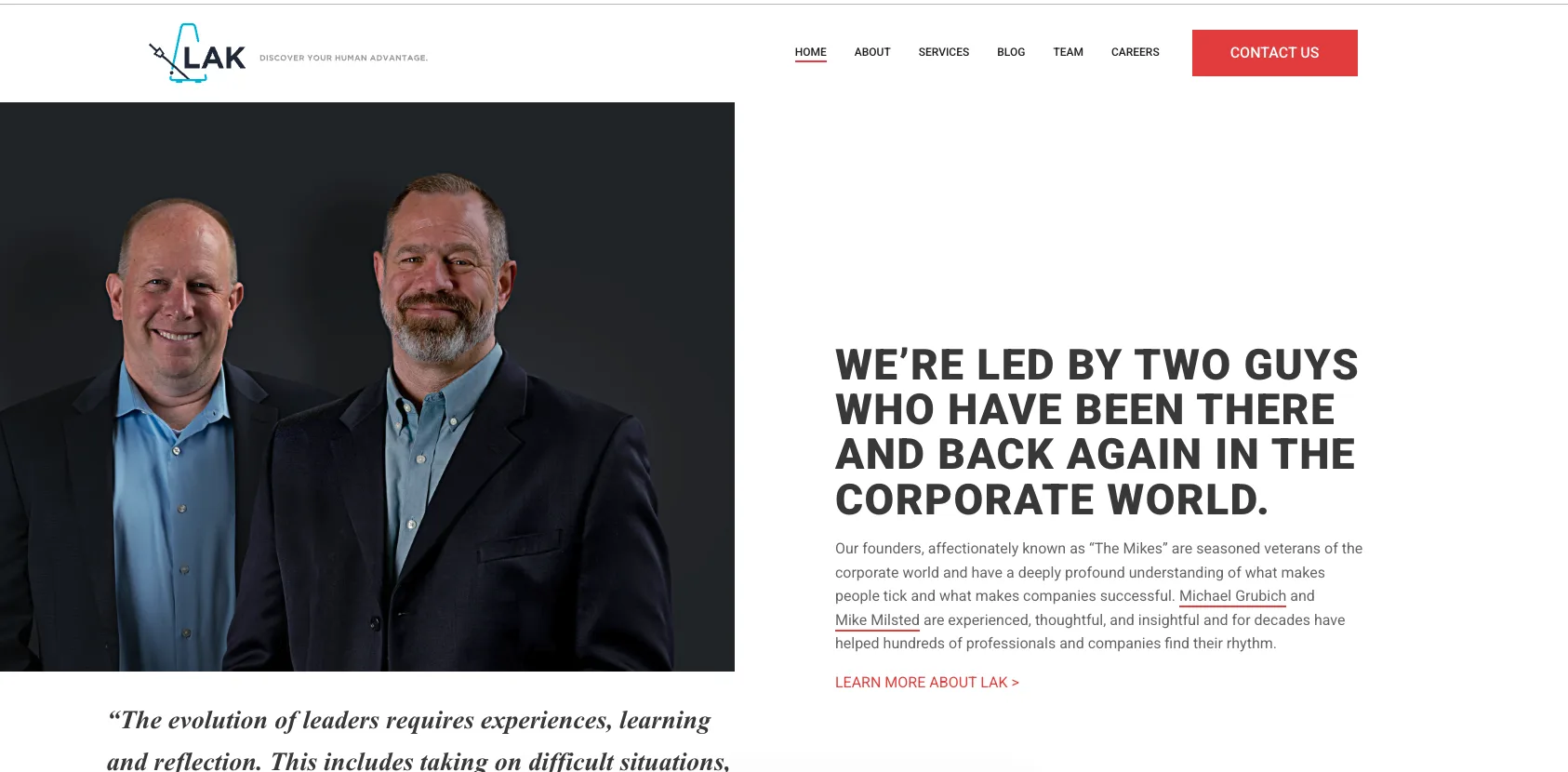
LAK Group is a US human-capital firm that works across the full talent lifecycle, from assessment and hiring through coaching, development, succession, and transition. Its team and executive coaching focuses on intact leadership teams: the group that has the right people but is not yet operating as one. LAK is built for the mid-sized company dealing with exactly that, not for a Fortune 1000 board alone.
What LAK Group does well
The coaching is run by people who have led teams. LAK staffs the practice with practitioners who have held senior line roles rather than career facilitators, so the coach in the room has usually sat inside the tension your team is under. LAK has published its own work on this, including a case study on breaking silos and improving communication across a senior executive team.
It coaches the team you have, not a template. There is no set curriculum every team runs through, so a newly merged leadership team gets different work from an intact team fixing broken handoffs. The engagement is scoped to what is actually breaking, which is the difference between coaching a team and running it through an offsite.
The work carries into real meetings. ORIEL, LAK’s AI coaching platform, joins standard meeting apps and gives feedback on how the team actually communicates in its ordinary meetings, and lets members rehearse a hard conversation before they have it. That reinforcement is where a team offsite usually fails, because nothing follows it into the weeks after.
It connects to the rest of your talent stack. The same firm runs assessment, leadership development, and succession, so what team coaching surfaces about who leads well under pressure can inform who runs which team next rather than staying in the room.
Where LAK Group falls short
LAK publishes no team coaching outcome metric. Heidrick & Struggles publishes that aligned teams outperform others by 23.5%, and CCL publishes detailed satisfaction and performance figures. LAK reports against the goals your team sets in the engagement, which is more useful once you are a client and less useful while you are choosing. Ask for references from teams like yours and what they measured.
It does not run large-cohort group coaching at platform scale. If what you want is group coaching for hundreds of unrelated managers at the lowest cost per head, BetterUp and GrowthSpace are built for that and LAK is not. LAK’s strength is the intact leadership team, not the volume cohort.
There is no published team-diagnostic instrument with an external benchmark. Heidrick benchmarks your team against top performers globally before the work starts, using its own diagnostic. LAK scopes from assessment and conversation rather than a branded team index, so if a board wants a named benchmark going in, ask LAK how it establishes the team’s starting point.
Best for
Mid-sized organizations coaching an intact leadership team through a real moment, a new leader, a merger, or a team that is not yet working as one, who want operators running the room and the work wired into assessment and succession.
2. Korn Ferry
Korn Ferry is a NYSE-listed organizational consulting firm with more than 8,600 employees and offices in over 50 countries. Its team coaching sits inside a business that also runs executive search, assessment, and organizational consulting, and arrives backed by the deepest proprietary assessment library in this comparison.
What Korn Ferry does well
Team coaching starts from measured data. Korn Ferry’s own validated instruments and leadership research let it profile a team before the work begins, so the coaching is anchored to assessment rather than to the coach’s read of the room. For a buyer who wants the starting point documented, that depth is the draw.
It connects team coaching to the rest of the talent picture. The same firm can assess your leaders, coach the team, and support succession, so a team engagement can feed decisions about who moves into which seat next. Few providers here span that much of the lifecycle.
The scale and reach are enterprise-grade. With offices across more than 50 countries, Korn Ferry can run team coaching for a leadership group spread across regions under one firm.
Where Korn Ferry falls short
Team coaching is one capability among many. The recurring criticism in competitive reviews is that engagements can feel templated, run to the firm’s frameworks rather than built around your team. Ask what differs between two team engagements at the same level in different companies.
The economics are built for large enterprises. Korn Ferry contracts around Fortune 1000 buyers and does not publish pricing, so a mid-sized company coaching a 12-person leadership team should ask for the smallest team engagement it will write before assuming it fits.
Credentials are published, operating history is less so. Ask who specifically will run your team’s sessions and what they have led, rather than accepting the firm’s brand as the answer.
Best for
Large enterprises that want team coaching anchored in proprietary assessment data and delivered alongside search and succession across multiple regions.
3. Heidrick & Struggles
Heidrick & Struggles is a retained executive search firm whose leadership practice covers assessment, one-to-one coaching, team coaching, and culture work. It has been recruiting, assessing, and coaching leaders for more than six decades, and team coaching is a real, data-backed practice inside it.
What Heidrick & Struggles does well
The team diagnostic is the strongest published in this set. Heidrick benchmarks your team against top-performing teams globally before the work starts, and publishes research showing that aligned, trust-based teams with clear goals outperform others by 23.5%. That instrument makes it the natural choice after a merger or a new CEO, when a board wants the starting point measured.
The coaches are senior. Many are former C-suite or functional leaders, so for a top team the person running the room has usually held a comparable seat. That peer credibility is the product at the board level.
Team coaching arrives with context. Because coaching sits next to search and board advisory, it comes with an understanding of how the team was assembled and what the board expects from it.
Where Heidrick & Struggles falls short
The center of gravity is the very top. Heidrick is built for boards and top teams, so a mid-level leadership team or a broad group coaching rollout is not the fit. Ask whether your team sits where the firm is strongest.
Coaching is the smaller practice inside a search-first firm. Ask how many of your team’s hours will be delivered by people whose full-time work is coaching rather than search.
Nothing is published on price, and the positioning is premium. For a mid-sized company, ask what a team engagement costs before you scope it, and expect a board-level number.
Best for
Organizations coaching a top team or a board through a transition, where the priority is a measured starting point and coaches who have held comparable seats.
4. CCL (Center for Creative Leadership)
The Center for Creative Leadership is a nonprofit leadership development institution founded in 1970, with roughly a dozen locations worldwide and more than 3,000 client organizations a year. Its team and group work runs through research-based programs, some for intact teams and many as open-enrollment cohorts.
What CCL does well
The research record is the deepest here alongside Korn Ferry’s. CCL pioneered the use of 360 feedback and the 70-20-10 model, so when a board asks what the team approach is based on, this is the easiest answer in the set to defend.
The outcome data and the prices are both public. CCL publishes that 97% of client organizations rate the work great or very great value, 94% say job performance improved, and 96% say leaders drove more organizational success, and it lists tuition for its open programs. No other provider here publishes both numbers.
The coach standard is published in detail. CCL selects from the top 3% of applicants, and every coach holds an advanced degree, recognized certification, and years of full-time coaching, delivered from a managed pool rather than a marketplace.
Where CCL falls short
The standard is coaching and research experience, not operating experience. Senior line leadership is not on the published list, so if you want the team’s coach to have run a business unit, ask about it specifically at the matching stage.
Open-enrollment economics do not bend. Group programs price per seat on set dates, so covering a whole team costs per person and the program is built to be excellent for the attendee rather than around your team’s specific breakdown.
There is no search or hiring assessment. CCL develops teams and does not help you select the people on them, so what surfaces in coaching does not feed a selection decision unless you carry it there yourself.
Best for
Organizations that want research-backed team and group development with published outcomes and prices, and are content with a proven program rather than one built around their team.
5. BetterUp
BetterUp is the largest coaching platform in this comparison, with more than 4,000 coaches across 70-plus countries and over 750 enterprise customers. Its group offering runs coaching circles and cohort-based programs, built to reach far more people than one-to-one team coaching can.
What BetterUp does well
Group coaching scales to the whole organization. BetterUp can run coaching circles across a large, distributed workforce, so a company wanting group coaching for hundreds of managers at once gets reach no boutique can match. This is group coaching built for volume.
The reporting is the most detailed in the category. BetterUp publishes a 14x average return and turnover reductions, and its dashboards show engagement and behavior change across a whole population, which suits a buyer who has to justify the spend upward.
The between-session layer runs inside daily tools. AI coaching sits in the applications people already use, so across a large group the work continues between scheduled sessions.
Where BetterUp falls short
It is group coaching, not intact-team coaching. Coaching circles bring together people who often do not work together, which develops individuals in a group rather than fixing how a specific team operates. For a leadership team that has to make decisions together, that is a different product from what you likely need.
Coaches do not know your team. They are matched from a large bench rather than embedded in your organization, which works for cohort development and less well for the particular dynamics of one team under pressure.
There is no assessment or succession layer. BetterUp is a coaching platform, so what surfaces about how people lead in groups does not feed selection or succession unless you carry it there.
Best for
Employers rolling group coaching out to hundreds or thousands of managers who want reach and reporting more than intact-team work.
6. GrowthSpace
GrowthSpace is a precision skill development platform with more than 2,800 experts across 65-plus countries. Its group offering runs cohort programs in which people who share a development need are matched to an expert for a focused sprint, with the outcome tracked against that need.
What GrowthSpace does well
Group development is tied to a specific skill and measured. GrowthSpace scopes a cohort sprint to a defined gap and tracks progress on it, which gives L&D a clean line from spend to outcome. For a group that needs one nameable capability, that focus is the appeal.
It matches cohorts by need. The AI matching pairs a group to an expert in the exact skill at issue across a wide catalog, so a cohort working on cross-functional influence gets a specialist in that rather than a generalist facilitator.
It runs individual and group work on one platform. GrowthSpace can support a team rolling out a shared skill while giving individuals targeted sprints, all with the same tracking.
Where GrowthSpace falls short
The model is skill development, not intact-team coaching. Sprint-and-measure fits a defined capability and fits the open-ended work of getting a leadership team to operate as a unit less well. For a team whose problem is trust and decision-making rather than a skill, ask whether the sprint format is the right container.
Experts are matched by skill, not by team-leadership seniority. Ask, for a senior team, what the matched expert has actually led, not only which skill they teach.
There is no talent stack around it. GrowthSpace develops skills and does not run hiring assessment or succession, so its outputs stay inside the program.
Best for
L&D teams that want measurable, skill-specific group development across cohorts rather than open-ended coaching of an intact leadership team.
Which team coaching service is right for you?
Korn Ferry fits a large enterprise that wants team coaching anchored in its own assessment data and sitting alongside search and succession. Heidrick & Struggles is the pick for a top team or board through a transition, with a measured starting point and coaches who have held comparable seats. CCL suits an organization happy with a research-backed program and published outcomes. BetterUp and GrowthSpace are built for group coaching at scale, BetterUp for reach and reporting across a large workforce, GrowthSpace for measurable, skill-specific cohorts.
The choice narrows when the job is an intact leadership team that has the right people and still is not operating as one. LAK Group coaches that team as a unit, puts people who have led teams in the room, scopes the work to what is actually breaking instead of running an offsite, and uses ORIEL to carry the change into the team’s real meetings. Assessment, development, and succession sit with the same firm, so what the coaching surfaces informs who leads next. Talk to LAK Group to scope it for your team.
FAQs
What is the difference between team coaching and group coaching?
Team coaching works with an intact team, the people who actually work together, on how the group makes decisions, handles conflict, and holds itself accountable. Group coaching brings together a cohort of people who often do not work together and coaches them at the same time, mainly to reach more people at a lower cost per head. Team coaching changes how one specific team operates; group coaching develops individuals in a shared setting. Confirm which one a proposal is selling, because the aim is different.
How much do team coaching services cost?
It ranges widely by model. Premium firms like Heidrick & Struggles and Korn Ferry price intact-team coaching at the board level and quote on request. CCL publishes seat prices for its open programs, so a group cost scales per person. Platforms like BetterUp and GrowthSpace price group coaching per seat on enterprise volume. LAK Group scopes to your specific team and quotes on request with no enterprise minimum. Ask for the all-in cost for your team, not a per-seat figure, and confirm whether it is built for a Fortune 1000 top team or a mid-sized leadership group.
When does a team need coaching rather than individual coaching?
When the problem lives between people rather than inside one of them. If your leaders are individually capable but the team misses handoffs, avoids conflict, or cannot make decisions together, coaching each person separately rarely fixes it, because the issue is how the group operates. Common triggers are a new leader inheriting a team, a merger that combines two teams, or a team that has the right people and still is not performing as a unit. Team coaching works on the group; individual coaching works on the person.
How do you measure the return on team coaching?
Decide what you will measure before the engagement starts. Sessions delivered and a better offsite tell you the work happened. The measures that tell you it worked are whether the team hit the goals it set, whether alignment and trust scores moved on a survey taken before and after, and whether the specific breakdowns you hired the coach to fix now hold. Some firms publish outcome data across their clients, such as Heidrick’s finding that aligned teams outperform others by 23.5%, but treat that as a track record across other teams rather than a forecast for yours.
Can one provider coach the team and the individuals on it?
Yes, and it is often the stronger setup. A provider that coaches the team as a unit and the individual leaders on it can connect what surfaces in the room to each person’s development, and, if the same firm runs assessment and succession, to who leads which team next. LAK Group coaches intact teams and individual leaders on one platform and ties both to the rest of its talent work, so the insight does not stay stuck in a single engagement.