

A talent assessment company gives your candidates a test, usually a questionnaire about how they work and often a reasoning test alongside it, and turns the answers into a written profile of the person. You use that profile to decide who to hire, who to promote, and who to invest in. The six providers below all do that, but they are not the same kind of company: some sell you the test and leave you to make sense of it, some run a platform that screens thousands of applicants at once, and some run the whole process for you, interviews included.
The tests are rarely the problem. They have been researched for decades and the leading ones work. What goes wrong is what happens to the profile once it arrives. It is a document full of scores and personality descriptions, and nowhere in it does it say hire this person or do not hire this person. Somebody has to read it, work out what it means for this particular job, and say so to the people making the decision. In most companies nobody is given that job, so the hiring manager skims the summary page, goes with the choice they were already leaning toward, and the profile is never opened again.
So the questions worth asking about talent assessment companies are not about whose test is best. They are about who turns the profile into a recommendation, what the test has actually been proven to predict, and whether anyone works with the person once the profile is filed. This article compares six providers on eight questions like those. Here is how they compare.
| Criteria | LAK Group | Hogan | SHL | Korn Ferry | Gallup | Predictive Index |
|---|---|---|---|---|---|---|
| Who turns the profile into a recommendation | LAK consultants run the interviews, talk your stakeholders through their reasoning, then deliver the written report | You or your consultant, after certification. Certification is required to use the personality suite, at $3,050 per person as of July 2026 | Reports are generated by the platform. Consulting is a separate service line | Korn Ferry consultants, or your own team through its certification programs | Reports are self-serve. Interpretation runs through an external directory of Gallup-certified coaches | Your own hiring managers by default, with PI-certified consultants available |
| What the test has been proven to predict | Selection and development. Interviews, testing and a written description of what strong performance in that specific job looks like | Selection and development. Everyday behavior, the habits that show up under pressure, and what motivates the person | Selection at volume and development. Reasoning ability, personality, judgment in work scenarios, hands-on skills, and 360 reviews | Selection, readiness for a bigger role, and development, across competencies, experiences, traits and drivers | Development only. Gallup states it is not validated as a predictor of success in a role and advises against using it to compare candidates | Selection and development. A behavioral questionnaire and a reasoning test, scored against the requirements of the job |
| Who owns the instrument and the research behind it | Selects research-based instruments per engagement and keeps the interpretation in-house. The research file belongs to whichever instrument is used | Owns its instruments. States the largest archive of work-related research in the industry, and hundreds of studies against real job performance | Owns its instruments. In the market since 1977, with 45 billion data points and 45 million assessments a year | Owns its instruments and publishes technical manuals for the four-dimension model | Owns CliftonStrengths and publishes a technical report. More than 90 years of data collection | Owns its instruments. 383 validity studies, 37.5 million assessments administered, and 70 years of research |
| Self-serve access, speed to a result, and volume hiring | None of the three. Every engagement is scoped in a conversation before it starts | Delivered online, but no report can be read until someone is certified. Not built as a hiring workflow | Built for volume. Candidate platform, video interviews and hands-on skills tests at 45 million assessments a year | Korn Ferry Assess runs from CEO to junior recruit on one platform, though engagements are still scoped and sold | Fully self-serve. CliftonStrengths 34 is $59.99 and takes about 30 minutes | Unlimited assessments and unlimited users on every plan, with job-match scoring and an interview guide per candidate |
| Whether the same firm works with the person afterward | Yes. Executive coaching and Coaching On Demand from the same firm, reinforced by ORIEL | No. Feedback is given by whoever holds the certification, inside your company or outside it | No coaching practice. Development services are sold separately | Yes. Executive coaching sits inside the same firm | Through an external directory of certified coaches rather than an in-house bench | No coaching. PI Inspire gives managers guidance based on the results |
| Where the information ends up a year later | With one firm that also runs your coaching, leadership development, succession, executive recruiting and outplacement | With whoever was certified. Hogan sells the instrument and reaches the market through 200+ partners across 66 markets | In SHL’s platform. SHL does assessment and people analytics and nothing beyond that | With Korn Ferry, which also runs your search, succession, coaching and organizational consulting. The widest reach here | In Gallup’s platform. Gallup covers engagement, culture and strengths development, with no search and no transition services | In PI’s platform, alongside hiring, team development and engagement. No search and no transition services |
| How results are measured | Against the decision the assessment was bought to inform. No published headline figure as of July 2026 | Return-on-investment studies run by its data science team. No published headline figure as of July 2026 | Publishes client outcomes, including 76% of new hires exceeding expectations for one retailer | Publishes client case outcomes, including a 25% share price increase and 10 to 25% higher engagement scores | Publishes research across its whole population rather than results for individual clients | Publishes 12% EBITDA growth, $180K annual attrition savings and a 20% attrition drop in key departments |
| What it costs, and whether you can see the price | No enterprise minimum and built for the mid-market, but quoted on request with no price published as of July 2026 | $3,050 a person to certify before the first report, plus assessment fees on top. No assessment pricing published | Enterprise volume contracting. No price published | Contracting built around Fortune 1000 buyers. No price published | $59.99 a person, bought self-serve. Organizational work quoted separately | Published. Talent starts at $10,000 a year and scales with headcount. Performance and Engagement are quoted |
Figures reflect what each firm published as of July 2026. Where pricing is not published it has to be requested, so confirm every number against your own quote.
What to look for in a talent assessment company
Eight questions separate these providers. Each one is worth asking before you sign anything, and the answers differ more than the sales decks suggest.
- Who turns the profile into a recommendation. The provider sends back scores and written descriptions of the candidate. It does not tell you whether to hire them. Somebody has to hold that profile against what this particular job demands and give your hiring committee an answer they can act on. Ask who that person is. If it is someone on your team, ask what training they need first and what it costs. If it is the provider, ask whether it is in the fee or billed separately.
- What the test has been proven to predict. Every test is checked against one specific claim. Some are checked to see whether people who score well go on to do the job well, which makes them useful for choosing between candidates. Others are only checked to see whether they describe how a person prefers to work, which makes them useful for developing somebody already hired. A test only has evidence for the claim it was checked against. Use the second kind to pick between two candidates and the prediction is weaker, and if the rejected candidate asks why they were turned down, there is no evidence behind the decision. Ask each provider in writing which of the two their test was checked against.
- How much research sits behind it. Ask for the technical manual and the number of validity studies, meaning studies that followed real employees and checked whether their test scores matched how well they actually did the job. That research is the only answer you have on the day a rejected candidate asks why.
- Whether there is a platform, and how fast you get a result. Screening 4,000 applicants for 60 openings is a different job from assessing three finalists for a division president. Platforms are built for the first: results come back the same day, at any volume. Consulting firms are built for the second: they take a few weeks and go far deeper on one person. Ask which of the two each provider is built for.
- What happens to the person after the report. An assessment tells someone how they behave under pressure, and then usually nothing happens, because the provider’s job ended when the report was delivered. Ask whether the same firm can coach them on what it found, or whether that means a separate vendor and a separate contract.
- Where the information ends up. An assessment produces one of the most detailed pictures of a person your organization will ever hold, so follow what happens to it. If the same firm also runs your succession planning, that picture is still there a year later when you decide who to promote. If it came from a vendor who only does assessment, the file stays in their platform and your promotion conversation starts from opinion again.
- What gets measured. Ask what the provider will show you after a year. Assessments completed and manager satisfaction tell you the program ran. How many assessed hires are still with you, and how many were promoted, tell you it worked. A vendor who sold you a test is not in the room for the decision or in the building a year later, so it can only report the first kind.
- Whether it fits an organization your size. Enterprise vendors set a floor on the contract, because their sales and support costs are much the same whether you assess 40 people or 4,000. Tools that require certification charge $3,050 for every person you train, whether it’s a 400-person company or a 40,000-person one. Ask for the smallest engagement each will write, and what you pay before the first candidate takes anything.
Two of those eight matter more than the rest. Ask each provider to put in writing what their test has been proven to predict. Then ask who will sit with your hiring committee on the day the profile is analyzed and a decision is due. That second question thins the field fast, because four of the six providers below sell a test and stop there. Everything after the profile arrives, the coaching, the promotion decision, the succession plan, is left to you.
1. LAK Group
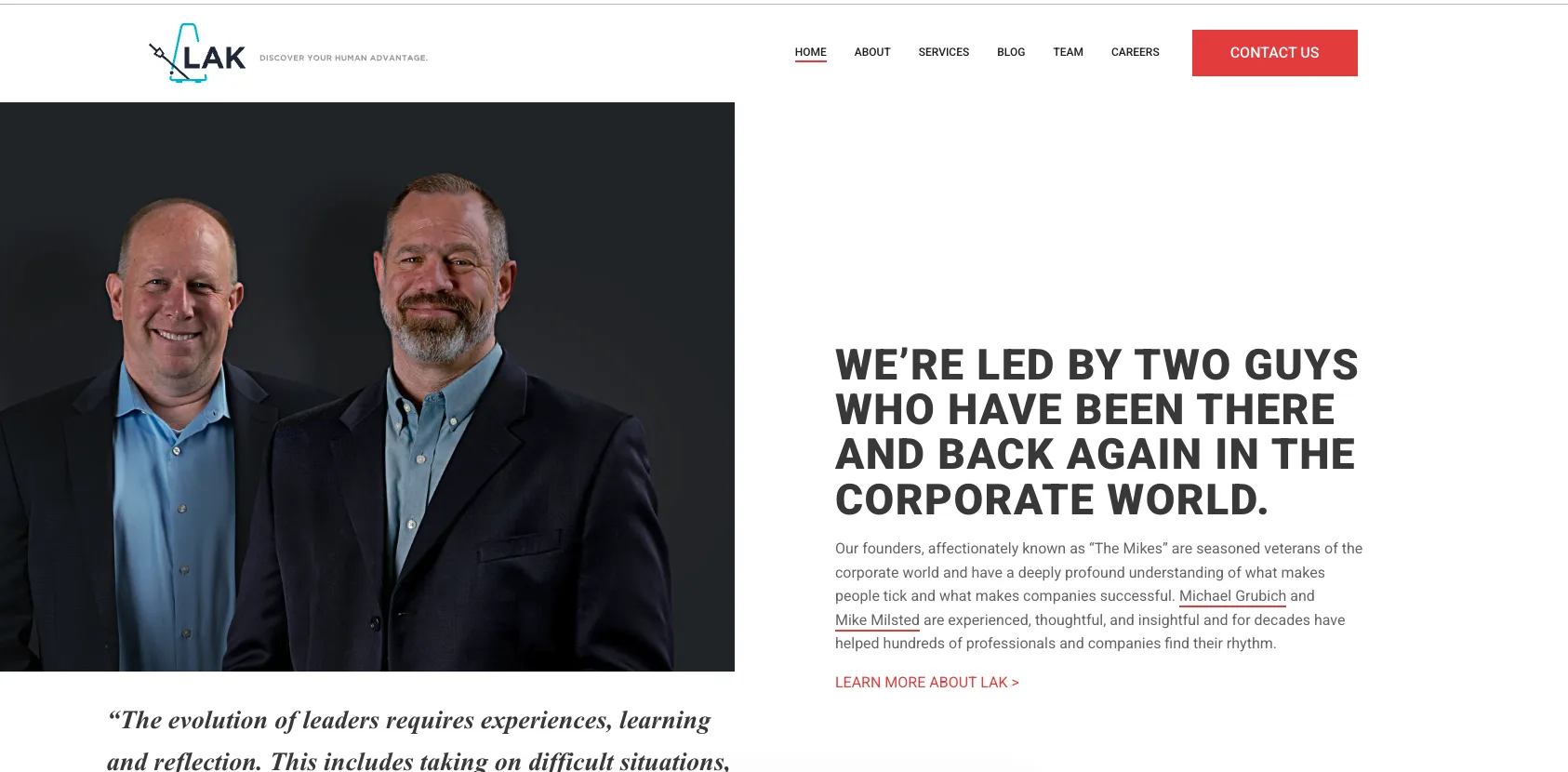
LAK Group is a US human-capital firm working across the full talent lifecycle, from assessment and hiring through coaching, development, succession, and transition. Its assessment practice is a service rather than a product, which is the main thing separating it from the five vendors below. LAK puts the cost of getting a senior hire wrong at 1.4 times that leader’s annual salary. Hire a $200,000 executive who does not work out, and finding and replacing them costs you around $280,000 once recruitment, lost productivity and the disruption to their team are counted. That is the number every fee in this comparison should be weighed against.
What LAK Group does well
Somebody reads the report with you. LAK combines interviews with behavioral assessment tools, talks your stakeholders through its reasoning, then delivers the written report. An instrument vendor sends the report and the interpretation becomes your problem. With LAK Group the interpretation is part of what you bought.
The assessment is built around the role rather than picked from a catalog. Before an executive assessment, LAK studies the role, the team, the organization, and the candidate, and writes a success profile: a description of what strong performance in that specific seat looks like. The interviews and the testing then run against that description, so two companies hiring the same job title get two different assessments.
One engagement covers both hiring and development. The same assessment is used for hiring and promoting managers, for checking how much leadership capability you hold in reserve, for identifying people worth accelerating, and for planning succession. Most vendors here sell those as separate products.
The work can continue after the report, if you choose to buy it. Executive coaching and Coaching On Demand are separate services on top of the assessment, but they come from LAK Group rather than from a second vendor you have to go and find. ORIEL lets a leader rehearse the interview, presentation, or difficult conversation the assessment flagged, then gives feedback on hesitation, eye contact, and the quality of the answers.
LAK Group also runs leadership development, executive recruiting, and outplacement. That matters a year later. When you sit down to decide who gets promoted, the firm that assessed the person has also been coaching them, and it is in the room for that conversation. Buy from a vendor who only does assessment and that year of information stays in their system.
Where LAK Group falls short
You do not end up owning an instrument. Hogan, SHL, and Predictive Index sell you a tested questionnaire plus the research file behind it, and once you have it you can run it on whoever you like. LAK selects instruments for the engagement and keeps the interpretation with its own consultants. That is a different purchase, not a cheaper version of the same one. If you want to own a tool and its evidence and run it yourself, buy from an instrument vendor.
There is no platform and no way to start on your own. Gallup will sell one person a report today for $59.99. Predictive Index gives you unlimited assessments on a subscription. With LAK you book a conversation, agree what the engagement covers, and begin after that. If you are screening 4,000 applicants for 60 seats, or you need a result this week, SHL or Predictive Index is the right shape and LAK is not.
The price is not published. Predictive Index lists $10,000 a year as its starting figure and Gallup lists $59.99 a head, so you can budget for either before speaking to anyone. LAK quotes on request, so the only way to compare it on cost is to send the same brief to every provider and wait. Ask for a range on the first call rather than the third.
No outcome figure is published either. Predictive Index publishes 12% EBITDA growth across its client base and SHL publishes named client results. LAK reports against the goals set inside your own engagement, which is the more useful measure once you are a client and the less useful one while you are choosing. Ask for references at your size, and ask those clients what they measured.
Best for
Mid-sized organizations making a small number of expensive leadership decisions a year, who want somebody to interpret the results with them rather than send a report, and who want the same firm to coach the person afterward.
2. Hogan
Hogan Assessments was founded in 1987 by Drs. Robert and Joyce Hogan and is the reference point for personality assessment at work. It has assessed more than 14 million people, operates in 51 languages and dialects, and reaches the market through more than 200 partners and authorized distributors across 66 markets.
What Hogan does well
The research base is the strongest in this comparison. Hogan states that it holds the industry’s largest archive of work-related research and has run hundreds of studies checking its scores against how people actually performed in the job. That is the easiest evidence in the set to put on the table.
Hogan measures three separate things, and the second is why most buyers come. The Hogan Personality Inventory covers how someone behaves on a normal day. The Hogan Development Survey covers derailers, meaning the habits that only appear under stress, which is what ends most senior careers. The Motives, Values, Preferences Inventory covers what motivates the person. No other provider here addresses the derailer question as directly.
Certification is quality control rather than a formality. It is required before anyone can use the personality suite, so nobody in your organization reads a Hogan report without being trained first. That protects against the most common failure in this market, which is a manager glancing at a profile and reading far more into it than the scores support.
Where Hogan falls short
You pay for the capability before you get the assessment. Certification runs two days in person or four half-days virtually, at $3,050 per person as of July 2026, and assessment fees sit on top of that. Certify two people so that one holiday does not stop the process, and you have spent $6,100 before a single candidate takes anything.
Hogan stops at the report. It makes instruments and sells them through partners, so the coaching, the development plan, and the promotion decision the profile was meant to inform all belong to somebody else’s contract. That is how the business is built. It is worth knowing before you buy.
The depth carries an ongoing cost. Three questionnaires need someone fluent to turn scores into a decision, which is why the certification exists. Budget for that person as well as the tests, and think about what happens when they leave.
Best for
Organizations with an internal talent function that can carry the certification, and that need the deepest published evidence available, particularly for senior hires where the worry is how the person behaves under pressure.
3. SHL
SHL has been in talent assessment since 1977 and handles more volume than anyone else here. It states that 45 million SHL assessments are taken every year, that it holds 45 billion data points on workforce skills, performance and potential, and that it provides answers to more than 10,000 organizations worldwide.
What SHL does well
Nothing here handles volume like SHL. If you hire thousands of people a year and need every applicant assessed the same way, the platform is built for that and has been doing it for decades.
The range of instruments is the widest in the comparison. SHL Verify tests reasoning and problem-solving. OPQ and MQ cover personality and motivation. Situational judgment tests put a candidate in a realistic work scenario and ask what they would do. There are hands-on tests for coding, technical work and languages, plus video interviews and a 360 review, which collects ratings on a leader from their manager, peers, and direct reports. The hands-on tests matter because they show you the work rather than a self-report about it.
Client results are published with numbers attached. SHL publishes that 76% of new hires exceeded expectations for one high-street retailer, and that 58% of high-fit candidates for critical leadership roles were women. Most vendors publish adjectives.
Where SHL falls short
The contracting model is enterprise. No pricing is published as of July 2026, and a platform built around 45 million assessments a year is not designed for an organization assessing forty people. Ask what their smallest contract looks like before investing time in a pitch.
Consulting is a separate service line, so unless you buy that too, what comes back is a report generated by software. That is the right trade when you are screening a thousand applicants and a thin one when you are choosing a division president.
Nothing follows the assessment. SHL measures and analyzes. Deciding what to do about the result, coaching the person, and planning where they go next all stay with you or with another vendor.
Best for
High-volume employers who need consistent, defensible assessment across thousands of applicants, and who have the internal team to act on what comes back.
4. Korn Ferry
Korn Ferry is a NYSE-listed organizational consulting firm with more than 8,600 employees and offices in over 50 countries. Assessment sits inside a business that also runs executive search, succession, coaching, and organizational consulting, which makes it the broadest provider in this comparison.
What Korn Ferry does well
The breadth is real and nobody else here matches it. One firm can find your next executive, assess them, coach them through the first year, and build the succession plan behind them. If you want all of that on one contract at global scale, this is the offer.
Its four-dimension model measures something the pure questionnaire vendors do not. Alongside competencies, traits, and drivers, Korn Ferry assesses experiences: the assignments a person has already had that prepare them for what comes next, such as running a turnaround or working abroad. When the question is whether someone is ready for a bigger job, that is often what decides it.
Korn Ferry Assess runs on one platform from CEO to junior recruit, so the same language and the same scoring apply across the whole workforce instead of changing at each level.
Where Korn Ferry falls short
The recurring criticism in competitive reviews is that engagements feel templated and process-heavy. Ask what actually changes between two assessments for the same level of role in two different companies. If the only difference is which report gets generated, the firm is running a standard process rather than designing the assessment around your situation.
Contracting is built around Fortune 1000 buyers and no pricing is published as of July 2026. Assessment is one capability among many rather than the whole business, so ask who runs your engagement day to day and what else is on their desk that quarter.
The breadth only pays off if you use several of the services. It is also worth naming out loud, before you sign, that the same firm assessing your candidates is the firm that recruited them.
Best for
Large enterprises that want assessment wired into executive search and succession under one global contract, especially when the question is whether someone is ready for a bigger role rather than whether to hire them.
5. Gallup
Gallup is a global analytics and advisory firm with more than 90 years of data collection behind it and over 4,000 organizations on its workplace performance platform. Its assessment is CliftonStrengths, a 30-minute questionnaire that ranks a person across 34 themes, meaning 34 patterns of thinking and behavior such as achieving, strategic thinking, or relationship building. More than 37.7 million people have taken it.
What Gallup does well
The scale creates a shared language. When 37.7 million people have taken the same assessment, a new hire often arrives already knowing their themes, and a team can talk about how it works together without first agreeing on a vocabulary.
Gallup is publicly honest about what its assessment cannot do. It states that CliftonStrengths has not been validated as a predictive measure of success in a given role, that it does not recommend using it to compare candidates or make employment decisions, and that buyers should use structured interviews built by studying what excellence looks like in the role instead. No other vendor in this comparison publishes a sentence that useful about its own product.
The entry price is the lowest here by a wide margin. CliftonStrengths 34 is $59.99 a person, bought self-serve, with no contract and no certification needed to receive the report. If what you want is a team development conversation next month, that is hard to argue with.
Where Gallup falls short
CliftonStrengths is not a selection tool, on Gallup’s own instruction. If you came to this list to improve hiring, CliftonStrengths is the wrong product and the company says so in writing. Buying it for selection anyway is the most common misuse in this category.
Coaching runs through an external directory of certified coaches rather than an in-house bench. Gallup certification requires a course, an exam, and six practice coaching sessions, which is a genuine standard. It still means the coach you work with is someone you found in a directory rather than someone answerable to your contract.
Gallup does not run executive searches, build succession plans, or handle people leaving the business. It measures and it develops. Everything downstream is your own project or another vendor’s.
Best for
Organizations that want a low-cost, widely recognized development and team language across a large population, and that already have a separate validated process for hiring.
6. Predictive Index
Predictive Index is a talent optimization platform used by more than 10,000 organizations. It reports 37.5 million assessments administered, 383 completed validity studies, and 70 years of research behind its two instruments: a behavioral questionnaire that describes how someone works, and a cognitive assessment that measures how quickly they learn and solve problems.
What Predictive Index does well
Predictive Index publishes its prices, which almost nobody in this market does. The Talent plan starts at $10,000 a year and scales with headcount, and every plan includes unlimited assessments and unlimited users with no charge per seat. You can build a budget before you take the first call.
The platform is built for the hiring manager rather than the specialist. Candidates are scored against the requirements of the job, and the platform generates an interview guide for each one, so the person actually making the decision gets something they can use in the room without sitting a certification course first.
Client outcomes are published with numbers attached: 12% EBITDA growth, $180K in annual attrition savings, and a 20% drop in attrition in key departments.
Where Predictive Index falls short
The cognitive testing is thinner than at the deep-research houses, and the platform is built to be used widely rather than to measure deeply. For one expensive executive appointment, Hogan and Korn Ferry give you more.
The platform is easy to use, and that is also the risk. A behavioral profile is quick to read and quick to read too much into, and interpretation sits with your hiring managers unless you arrange otherwise. PI-certified consultants are worth using on the decisions that matter.
There is no coaching, no search, and no support for people on their way out. PI Inspire gives a manager guidance based on the results. It does not give the person a coach.
Best for
Mid-sized and growing companies that want behavioral and cognitive assessment in the hands of hiring managers across the whole organization, at a price they can see before the first call.
Which talent assessment company is right for you?
Each of these fits a specific case. Hogan is the pick when you need the deepest published evidence and you can carry the certification internally, especially when the worry is how someone behaves under pressure. SHL is built for assessing thousands of applicants consistently. Korn Ferry suits an enterprise that wants assessment bundled with executive search and succession worldwide. Gallup is the cheapest route to a shared development language, provided you keep it away from hiring decisions, as Gallup itself recommends. Predictive Index fits when you want assessment in the hands of hiring managers and a published price to budget against.
If your problem is that the report keeps arriving and nothing happens next, the list gets shorter. LAK Group runs assessment as an engagement rather than a subscription. Consultants write a description of what strong performance in the role looks like, then interview and test against it. They sit with your stakeholders and work through what the results mean before anything is committed to paper. The same firm then coaches the person, so a year later, when you are deciding who to promote, what the assessment found is in the room instead of in a vendor’s platform. To scope what that looks like for the decisions in front of you, talk to LAK Group.
FAQs
How much do talent assessments cost?
Two of the six publish a number. Gallup sells CliftonStrengths 34 at $59.99 a person, self-serve. Predictive Index publishes a Talent plan starting at $10,000 a year with unlimited assessments. Hogan publishes $3,050 per person for the certification you need before you can use its personality suite, with assessment fees charged separately. SHL, Korn Ferry, and LAK Group quote on request. Compare cost per decision rather than cost per test, and add up the certification, the platform fee, and the hours it takes somebody to turn a report into an answer.
Do you need to be certified to use talent assessments?
It depends on the instrument. Hogan requires certification before you can use its personality suite: two days in person or four half-days virtually, at $3,050 per person as of July 2026. Korn Ferry and Predictive Index run certification programs but will sell to you without one. Gallup needs no certification to receive a report, and certifies coaches separately. With LAK Group the interpretation sits with the provider, so nobody on your side needs certifying. Where a tool is gated, add the training cost to the comparison and plan for the trained person leaving.
Can you use a strengths assessment to make hiring decisions?
Gallup says no, and it is the clearest published answer in the category. It states that CliftonStrengths has not been validated as a predictive measure of success in a given role, and does not recommend using it to compare candidates or make employment decisions. It points buyers to structured interviews built by studying what excellence looks like in the role, then using strengths for development once the person is hired. A development tool used for selection gives a weaker prediction and leaves you nothing to point at if the decision is challenged.
What is the difference between an assessment tool and an assessment company?
A tool sells you a tested instrument and a report, and what you do next is up to you. A company sells you a recommendation: it works out what strong performance in the role looks like, chooses and runs the instruments, interviews the person, and tells you what it thinks you should do. Hogan, SHL, and Predictive Index are primarily tools. LAK Group and Korn Ferry are primarily companies. The tool costs less per person and scales further. The company costs more per decision and earns it when the decision is expensive to get wrong.
We have 400 employees and nobody trained in assessment. Which of these will work for us?
Rule the enterprise models in or out first. SHL and Korn Ferry contract around high volume and Fortune 1000 buyers, so ask each for the smallest engagement they will write before spending time on a pitch. Predictive Index publishes a starting price and runs without a specialist on staff. Hogan is excellent, but assumes somebody internal gets certified, which is $3,050 and a skill you then have to keep. Gallup works for development at $59.99 a head and should not be used for selection. LAK Group sets no enterprise minimum and supplies the interpretation itself, which at your size is usually what you are short of.