

An executive search firm gets hired to fill one senior role. You pay a flat fee for the search itself. It’s usually split into three payments across the two or three months it takes, and you owe that fee whether or not you hire one of their candidates. The firm builds a list of the people who already hold that job at other companies, approaches them privately, interviews and reference-checks the serious ones, and gives you a shortlist to meet. Headhunter is the older word for the same work.
Companies hire these firms for two very different reasons, and most comparison lists blur the two together. The first reason is a board hiring a chief executive, or another role at the top of a public company. What that board is paying for is access and reassurance: a firm whose partners have known the small number of credible candidates for years, and whose name carries weight with investors.
The second reason is a mid-sized company hiring a VP or a department head. Finding a good candidate is the straightforward part of that job. The difficult part is that the person has to still be in the role, and doing it well, a year later. A firm that disappears once the offer is signed leaves that risk with you.
We compare six firms below. Five of them are global search leaders, and they are the right choice for the board-level hire described above. The sixth, LAK Group, is built for the mid-sized company that has to keep the person it hires. The table scores all six against the seven questions worth asking any search firm before you sign.
Figures reflect what each firm published as of August 2026. None of the six publish fee schedules or replacement guarantees, so those are not compared below.
| Criteria | LAK Group | Korn Ferry | Heidrick & Struggles | Russell Reynolds | Egon Zehnder | Spencer Stuart |
|---|---|---|---|---|---|---|
| How the search connects to your talent plan | One stage of a lifecycle: assess, hire, onboard, coach, retain | Broad one-stop, run as separate practices | Search plus Senn Delaney culture work | Search plus succession advisory | Search plus board advisory and development | Search plus board services and CEO succession |
| Fit and cost for a mid-sized organization | Built for mid-sized employers | Priced for the Fortune 1000 | Premium, often 2 to 3 times a boutique | High fees; smaller searches may wait | Enterprise and board level | Large enterprise and board level |
| Who runs the search day to day | A senior practitioner who has held line roles | Sold by partners, often run by junior consultants | A senior partner leads, a team executes | Consultant-led with a research team | All-partner model, no associate layer | Consultant-led with research support |
| What happens after the hire | Transition coaches onboard the new leader | Onboarding sold separately | Executive onboarding sold separately | Assessment and onboarding sold separately | Integration sold as a separate engagement | Onboarding and assessment sold separately |
| Time to fill | High-touch, smaller bench, can take longer | Large global research bench, fast slate | Deep bench, fast at the senior end | 1,900+ staff, broad sourcing capacity | 600+ partners, thorough and deliberate | 300+ consultants with research support |
| Which companies they cannot recruit from | A smaller number of select clients, so most companies are open to approach | Hundreds of large clients, so many are blocked | Large client list, so many are blocked | Large client list, so many are blocked | Large client list, so many are blocked | Large client list, so many are blocked |
| Depth of network at the executive level | National, mid-market network | 50+ countries, deep global C-suite network | Global senior executive and board network | 45+ cities worldwide | 71 offices in 37 countries | Approximately 70 offices in 30+ countries |
What to look for in an executive search firm
All six of these firms will find you senior candidates. What separates them is how the search is run, and what the firm is still responsible for once your new leader starts. These seven questions will tell you most of what you need to know about any firm on this list.
- How the search connects to your talent plan. A search can be a standalone transaction or one step in a plan that also assesses, develops, and retains the person. A standalone firm hands you a hire and closes the file. A connected firm still has a stake in how that leader performs in month nine. Ask which one you are buying, because it decides who owns the outcome after the offer is signed.
- Fit and cost for a mid-sized organization. A firm that normally handles Fortune 500 board searches will charge you at that same level for a VP role at a mid-size company. Its offices, research staff, and partner salaries are all built around much larger work, and that cost is passed into your fee. If you are hiring below the C-suite, you are paying for a global reputation your search does not need.
- Who runs the search day to day. Many firms sell the search with a senior partner and then hand the calling and screening to junior researchers. The partner reappears to present the shortlist. Ask who reads the market and speaks to candidates, by name, and how often you will hear from them.
- What happens after the hire. A senior hire fails slowly, not on day one. Somebody who was right on paper can still be gone in fourteen months, and by then you are paying a second fee to replace them. A firm that onboards and coaches the new leader protects the placement. A firm that stops at the offer letter leaves that risk with you.
- Time to fill. A large firm with a global research bench can build a slate in weeks because dozens of people are working the list. A smaller firm doing more of the search by hand takes longer. Speed is a real advantage, and it is a fair trade against fit. Decide which one costs you more in your situation.
- Which companies they are not allowed to recruit from. A search firm promises its own clients that it will not approach their staff. That promise is called an off-limits restriction, and it holds for as long as the client relationship does. The more clients a firm has, the more companies it is barred from calling on your behalf. A firm with hundreds of large clients may be blocked from approaching the exact competitors whose people you want to hire.
- Depth of network at the executive level. For a global board seat, the firm’s existing relationships with sitting executives are the product. Decades of placements across dozens of countries cannot be replicated by a smaller firm. If your search is genuinely global and top-tier, this is where scale earns the fee.
The big global firms win on two of these seven questions. They know more senior executives, and they can put a shortlist together faster. That comes from decades of relationships across dozens of countries and research teams of several hundred people, which no mid-sized firm can match. So if you are hiring a public-company CEO or filling a board seat, those two questions can be decisive.
The other five are where mid-market searches are won and lost, and they tend to run the other way. The firms below are ordered with that split in mind.
1. LAK Group
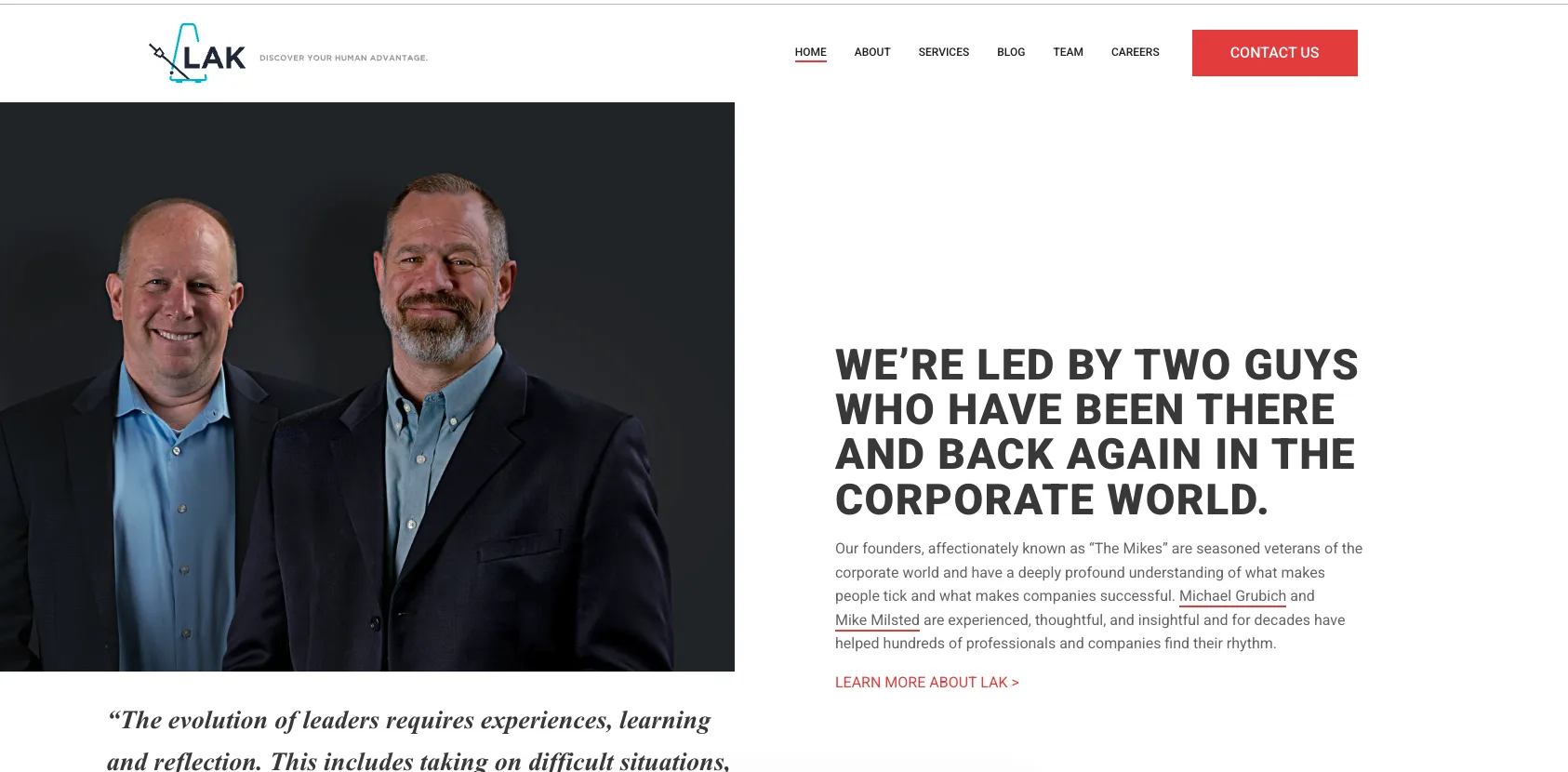
LAK Group is a US human capital firm working across the full talent lifecycle: assessment, hiring, leadership development, coaching, succession, and outplacement. Executive recruiting sits inside that, which is both the argument for using them and the reason they are the odd name on this list. Every other firm here is a search firm first.
What LAK Group does well
The search does not end at the offer letter. LAK’s process runs in three stages, and the third one is the difference: transition coaches work with the new leader after they start, to shorten the time until they are productive and to keep them in the seat. Most firms here sell that separately, if they sell it at all.
The role gets defined before anyone is approached. The first stage builds an assessment framework for the job, so selection, development, and succession planning are aligned to the same picture of what the role needs. That work draws on LAK’s own assessment practice rather than a personality test bolted on at the shortlist stage.
One firm covers the hire and everything that follows it. The same partner can connect the search to executive coaching, leadership development, and succession planning, so a VP hire is not a standalone event but part of a bench you are building. There is one point of accountability instead of three vendors pointing at each other.
A smaller client roster leaves more of the market open. LAK is not carrying hundreds of enterprise accounts, so off-limits restrictions block far fewer companies. In practice that means LAK can approach leaders at organizations a global firm is contractually barred from calling.
The person who wins the work runs the work. LAK’s recruiters are practitioners who have held senior line roles, so the person assessing whether a candidate can run your operation has run one. There is no hand-off to a research team you never meet.
Where LAK Group falls short
LAK’s network is national, not global. LAK does not have the multi-country network of senior contacts that the five firms below have built up over decades. If your next executive could just as easily come from Frankfurt or Singapore as from Chicago, those existing relationships are the main thing you are paying a search firm for, and LAK does not have them at that scale. For a board-level hire at a global company, one of the five firms below is the better choice.
The process can take longer. LAK does more of the search by hand and does not have a research bench of hundreds to assemble a slate in days. If you need a shortlist inside three weeks, say so at the first meeting and get a straight answer before you sign.
Nothing is published. LAK does not publish a fee schedule, a replacement guarantee, or placement and retention figures. None of the other five publish them either, so there is no way to compare any firm on this list on paper. Ask LAK for retention figures on recent placements in the first meeting, and for the fee structure in writing before you sign.
Best for
A mid-sized company hiring a senior leader it then has to keep, that wants assessment, onboarding, and coaching wired into the search rather than bought separately afterward.
2. Korn Ferry
Korn Ferry is a NYSE-listed organizational consulting firm with more than $2 billion in revenue, 8,600-plus employees, and offices in over 50 countries. Executive search is one practice inside a business that also sells assessment, leadership development, and organizational consulting.
What Korn Ferry does well
The breadth is real and it is contractable. One firm can run the search, assess the finalists against a role profile, and build the development plan for whoever gets hired, on a single master agreement. For a large company consolidating vendors, that is worth money on its own.
Korn Ferry does excellent research, and its assessments are widely respected. The KF4D model and its underlying data give HR buyers something defensible to show an executive committee, which matters when a hiring decision has to survive internal scrutiny.
The research bench moves fast. With thousands of staff across 50-plus countries, Korn Ferry can put a credible slate in front of you quickly and run parallel searches in several markets at once.
Where Korn Ferry falls short
Engagements are repeatedly described as templated and process-heavy. The methodology that makes the firm scalable is the same thing that makes an engagement feel like it was run off a checklist rather than built around your business.
The people who sell the search are not always the people who run it. Senior partners lead the pitch, and more junior consultants often carry the day-to-day work. Ask who owns the search after the contract is signed, and get the answer in writing.
Contracting is built around Fortune 1000 buyers. For a mid-sized company hiring below the C-suite, the fee reflects a global apparatus you will use very little of.
Best for
A large enterprise that wants executive search, assessment, and leadership development from one global vendor, on one contract.
3. Heidrick & Struggles
Heidrick & Struggles is a premium executive advisory firm with more than $400 million in revenue, 2,000-plus people, and offices in over 50 countries. Through Senn Delaney it also runs one of the better-known culture consulting practices.
What Heidrick & Struggles does well
Heidrick has excellent senior recruiters, and for a single C-suite seat with a specific board-fit requirement they are a legitimate option. The firm is known in the rooms where CEO appointments actually get decided, and that access is difficult to buy any other way.
The senior network is deep and genuinely global. For a chief executive or board search, the relevant candidates are a few hundred people worldwide, and Heidrick already knows most of them.
Culture work attaches to the search. Senn Delaney means a top-team appointment can connect to the culture that team is meant to lead, which is more than a search-only firm can offer.
Where Heidrick & Struggles falls short
The premium is steep, often two to three times a boutique or mid-market fee. That is defensible for a CEO hire and hard to justify for a functional head.
The firm is concentrated at the very top. Below the C-suite it is a weaker fit, and it cannot profitably serve Director and VP hiring at scale, which is where most mid-sized companies actually need help.
Search comes first culturally. Work that follows a placement can be an afterthought, so if what happens in the first 90 days matters to you, confirm exactly what is included before signing.
Best for
A board or CEO search where reputation, discretion, and existing board relationships matter more than what the search costs.
4. Russell Reynolds Associates
Russell Reynolds Associates is a global executive search leader with an estimated $500 million-plus in revenue, 1,900-plus staff, and offices in more than 45 cities across the US, Europe, and Asia.
What Russell Reynolds does well
Multi-market capacity is the strength. A search that spans three continents can be staffed and run without subcontracting to affiliates, which keeps the process and the assessment standard consistent wherever the candidate sits.
The firm recruits senior leadership across both companies and mission-driven organizations, so a candidate pool that crosses sectors is familiar ground rather than a special case.
Capacity is deep enough for broad, high-profile mandates. If you need several senior seats filled at once after a restructure or an acquisition, the bench is there.
Where Russell Reynolds falls short
Fees are high enough to be prohibitive for smaller organizations, and the firm is built around large mandates. A smaller search may sit behind a marquee one in the queue, so ask directly where your role ranks in the team’s current workload.
The engagement is a search and it ends at the placement. Assessment and onboarding advisory exist but are sold separately, so keeping the leader is a second purchase.
Best for
A large organization running a high-profile senior search across several markets at once, where global sourcing capacity outweighs cost.
5. Egon Zehnder

Egon Zehnder was founded in Zurich in 1964 and states more than 600 consultants across 71 offices in 37 countries. It runs executive and board search alongside board advisory and leadership development.
What Egon Zehnder does well
Every consultant is a partner, and there is no associate layer to hand your search down to. This is a genuine strength, and on the question of who actually runs the search, Egon Zehnder answers it better than anyone else on this list, LAK Group included. The person who wins the work is the person who calls the candidates.
The one-firm structure removes the internal competition. Partners share work across offices rather than protecting their own accounts, so a search that needs someone in Frankfurt gets that person instead of a phone introduction.
Board advisory and leadership development sit alongside the search, so a CEO appointment can connect to board review work and to development for the team underneath the new hire.
Where Egon Zehnder falls short
The orientation is enterprise and board level. A mid-sized company hiring a functional head is not the client this model is built around, and the fee follows the enterprise posture.
Development and integration are a separate engagement rather than part of the search, so support after the hire is a second conversation and a second invoice.
Egon Zehnder publishes no fee schedule, no guarantee terms, and no placement metrics, which makes it difficult to compare on anything except reputation.
Best for
A board or CEO search where you want one senior partner accountable end to end, with no hand-off to a junior team.
6. Spencer Stuart

Spencer Stuart was founded in 1956, is headquartered in Chicago, and is widely described as the largest privately held search firm in the world. It runs about 70 offices across more than 30 countries with 300-plus consultants.
What Spencer Stuart does well
Board services and CEO succession are the firm’s strongest practices. For a board planning a chief executive transition over 18 months rather than filling a vacancy in a hurry, that depth is the reason to call.
Private ownership means no quarterly earnings pressure, which shows up as a willingness to work long succession timelines that do not produce a fee this quarter.
The consultant base is large enough to staff complex searches while keeping the firm’s assessment standard consistent across markets.
Where Spencer Stuart falls short
The focus is large enterprise and board work. A mid-sized company hiring below the C-suite is not the core client, and the engagement will be priced and scoped for a larger buyer.
Onboarding and assessment are offered as separate services rather than built into the search, so the firm’s responsibility ends when the candidate accepts.
Spencer Stuart publishes no fees, guarantee terms, or placement metrics, so a comparison comes down to references and reputation.
Best for
A large enterprise or board planning a CEO succession, where board-level depth matters more than anything that happens after the appointment.
Which executive search firm is right for you?
If you want search, assessment, and leadership development from one global vendor on one contract, Korn Ferry is the consolidation play, and the fee reflects the breadth whether or not you use all of it.
For a board seat or a CEO hire, where reputation and existing board relationships decide the outcome, Heidrick & Struggles is the premium option and worth the premium.
Russell Reynolds Associates suits a high-profile senior search running across several markets at once, where sourcing capacity is the binding constraint.
Egon Zehnder is the answer when the thing you care about most is that one senior partner runs the entire search, with nothing handed to a junior team.
A board planning a chief executive transition over a long horizon will find Spencer Stuart’s succession and board practice hard to match.
And if you are a mid-sized company hiring a leader you then have to keep, finding the person is the easy half. The real question is who is still accountable in month nine.
That is the case LAK Group is built for: the search connects to assessment, onboarding, and coaching, so the firm that finds your VP is still involved when it matters. If you are about to open a senior role, book a conversation with LAK Group to talk through what it will take to keep that person in the seat.
FAQs
What is the difference between an executive search firm and a headhunter?
They describe the same work. Headhunter is the older, informal word for someone who recruits a specific senior person, usually one seat at a time. Executive search firm is the formal version: a retained team that maps the market, approaches people who are not job hunting, assesses them, and manages the offer. Every firm on this list is what people mean by both terms.
How much do executive search firms charge?
Retained executive search is typically priced at about one third of the role’s first-year cash compensation, billed in stages across the search rather than on placement. None of the six firms here publish a fee schedule, so you get a quote once the role is scoped. The fee scales with the seniority of the hire, so a CEO search costs several times what a functional head costs.
What is an off-limits restriction, and why does it matter?
A retained firm agrees not to recruit from its own active client companies, usually for the length of the relationship and a period after it. That protects the firm’s clients, and it also shrinks your candidate pool. A firm with hundreds of enterprise clients may be blocked from approaching the exact competitors whose leaders you want. Ask which companies are off-limits before you sign, not after the shortlist disappoints you.
What is the difference between retained and contingency search?
Retained means you pay across the engagement whether or not a hire is made, and the firm works the role exclusively. Contingency means you pay only when someone is placed, and several agencies may be working the same role. All six firms here run retained search, because senior hiring is confidential, takes months, and requires depth that a pay-on-placement model does not fund.
Which executive search firm is best for a mid-sized company?
The global giants are priced and scoped for larger buyers, so a mid-sized company usually pays for reach it will not use. LAK Group is built for the mid-market and ties the search to assessment, onboarding, and coaching, which matters because the expensive failure is not a slow search, it is a senior hire who leaves in year one. If retention is your real concern, weight what happens after the hire more heavily than brand.