

A culture consulting firm is hired to change how your people behave at work. Most engagements follow the same four steps. The firm measures your culture today. It defines the culture you want. It works on how your leaders behave. Then it puts something in place to hold the change once the consultants leave.
Most of the money in this market is spent on measurement. Surveys are easy to buy, and they produce a report your board can read. Changing how leaders behave is the hard step, because it asks senior people to do something different on Monday morning. It is also where engagements quietly stop.
The firms we are analyzing in this article are not competing for the same work. Some are very good at telling you where you stand, and go no further. We compare six of them below on the eight questions worth asking before you sign. Figures are what each firm published as of August 2026, and none of them publish a price.
| Criteria | LAK Group | Heidrick & Struggles | Korn Ferry | Gallup | Culture Partners | Workhuman |
|---|---|---|---|---|---|---|
| Who delivers the work | Practitioners who have held senior line roles, working directly with your leaders | Partners from the Senn Delaney culture practice, with a team delivering | Organization strategy consultants, sold by senior partners and delivered by consulting teams | Gallup consultants, plus an academy director of certified coaches for the strengths work | A consulting bench trained in the firm’s own methodology | Software and a customer success team. No consultants doing culture work |
| Where the work starts | Objectives linked to your business strategy, then a five-step process fitted to them | A two-part model, beginning with the case for change and CEO ownership | The Organizational Culture Assessment, mapped into culture types and culture shifts | The Q12 engagement survey and its benchmark database | The Results Pyramid, the accountability model from The Oz Principle | Deployment of the recognition platform |
| Whether culture work is tied to leadership behavior | Yes. Setting behavioral expectations for leaders is step two of five | Yes. Culture is shaped by the leadership shadow, and the CEO has to own it | Yes, through leadership models, capability frameworks, and succession | Manager-centric. Its own research points to manager selection and development | Yes, through the experiences leaders create for their teams | No. Its mechanism is peer-to-peer recognition, not leader behavior |
| How the culture is diagnosed and measured | A culture scorecard run throughout the engagement. No published instrument or benchmark data | Uses a range of diagnostics, with client outcome figures published rather than benchmarks | The Organizational Culture Assessment, built on more than a decade of its own primary research | The Q12, validated through meta-analysis across millions of responses, with benchmarks | A survey scoring the four layers of the Results Pyramid | Continuous platform analytics drawn from recognition activity |
| How far the work reaches across the workforce | Leaders and their teams. Employees are reached through the leaders above them | Concentrated on the CEO and top team, cascading down from there | Enterprise-wide, at enterprise scale and price | Every employee, through repeat surveying | Leaders first, then the daily routines their teams run on | Every employee, every day. Eight million users across 100+ countries |
| How it connects to the rest of your talent strategy | Culture sits with coaching, assessment, development, succession, and outplacement under one point of accountability | Connects to executive search and leadership advisory in a search-led firm | Links search, assessment, development, and rewards, run as separate practices | Connects to performance and manager development. No search, succession, acquisition, or transition services | Culture only. Not connected to how you hire, promote, or exit people | Recognition data feeds HR systems. Not a talent strategy partner |
| Fit and cost for a mid-sized organization | Built for mid-sized organizations. No published price as of August 2026 | Premium, often 2 to 3 times a boutique fee; built for large global corporations | Priced for the Fortune 1000 | Q12 self-serve entry through published assessment prices; the advisory work is quoted | Mid-to-large companies. Anything from a one-hour keynote to a multi-year program | Reviewers describe it as heavy in cost and complexity for smaller organizations |
| What sustains the change after the engagement ends | Step five is sustain: measure, reinforce, integrate into talent and business processes, and hold people accountable | No. Yet execution is the fifth priority, sustained through leadership ownership | Embedded in capability models, succession, and workforce systems | Repeat surveying and manager development, for as long as you keep buying the platform | Behavior embedded into daily routines, with quarterly culture reviews | The platform keeps running. It is a subscription rather than an end state |
What to look for in a culture consulting firm
All six of these firms will tell you something true about your culture. What separates them is what happens after that, and who is responsible for it. These eight questions will tell you most of what you need to know about any firm on this list.
- Who delivers the work. Culture work happens in a room with your leaders, so the question is who is in that room. Some firms send consultants who have advised on culture their whole careers. Some send practitioners who have run a business unit and carried the budget. Some send nobody, because the product is software. Ask who will be there, what they have run themselves, and whether they are the people who sold you the work.
- Where the work starts. Every firm here has a model. The difference is whether the model or your business comes first. A firm that starts from its own framework gives you a tested structure and a shape you have to fit into. A firm that starts from your objectives builds around what you are trying to achieve, with less of a template to lean on. Neither is wrong, but knowing which one you bought prevents the surprise in month three.
- Whether culture work is tied to leadership behavior. Culture is what people do when a decision is hard, and that follows what their leaders do. A program that changes leader behavior changes what employees actually experience. A program that runs past leaders, through values statements or a recognition feed, leaves the daily experience untouched. If your leadership team is not in the work, ask what exactly is expected to change.
- How the culture is diagnosed and measured. You need a read on where you stand and a way to tell whether anything moved. The strongest instruments come with a benchmark database, so you can compare yourself against thousands of other organizations rather than against your own last score. That comparison is useful, and it is also where measurement gets mistaken for change. Gallup, which sells one of those instruments, publishes the warning itself: “An annual survey by itself does not help anyone.” Budget for what happens after the report.
- How far the work reaches across the workforce. A platform touches every employee every day. A consulting engagement touches your leaders, and reaches everybody else through them. Breadth buys visible activity across 5,000 people in a quarter. Depth buys a leadership team that behaves differently, which takes longer and changes more. Decide which of those your problem is before comparing prices, because the two are priced on different logic.
- How it connects to the rest of your talent strategy. Culture is set by who you hire, who you promote, what you measure, and who you let go. A firm that only does culture changes how your leaders behave, then hands the work back at the edge of your hiring and promotion processes. A firm that also runs assessment, coaching, and succession can change those processes too. If the culture work never reaches your talent decisions, the old culture gets reinstalled every time you hire.
- Fit and cost for a mid-sized organization. None of these six publish a price for culture work, so cost comes down to who the firm is built for. A global advisory firm carries a cost base built around Fortune 500 programs and quotes accordingly, whatever the size of your problem. Ask for a scope and a number early, and ask which companies your size they have done this for in the last two years.
- What sustains the change after the engagement ends. The failure mode is the six-month fade: the workshops land, behavior shifts, then the quarter gets hard and everybody reverts. What holds is mechanical rather than motivational. Reinforcement built into routines that already exist, measurement that keeps running, and the new expectations written into how people are hired, reviewed, and promoted. Ask what will still be running a year after the last invoice.
On two of these eight criteria, the measurement firms come out on top. Gallup is the strongest at diagnosing where you stand, because nobody else has a validated survey with millions of responses behind it. Workhuman reaches every employee directly in a way no consultancy here can match. If you genuinely do not know what your culture is today, or you need visible activity across a large workforce quickly, treat those two as the deciding factors.
The other six criteria are the ones that decide whether a leadership team actually changes: who delivers the work, where the work starts, whether it is tied to how your leaders behave, how it connects to the rest of your talent plan, what it costs an organization your size, and what sustains the change after the engagement ends. The firms below are ordered with that in mind.
1. LAK Group
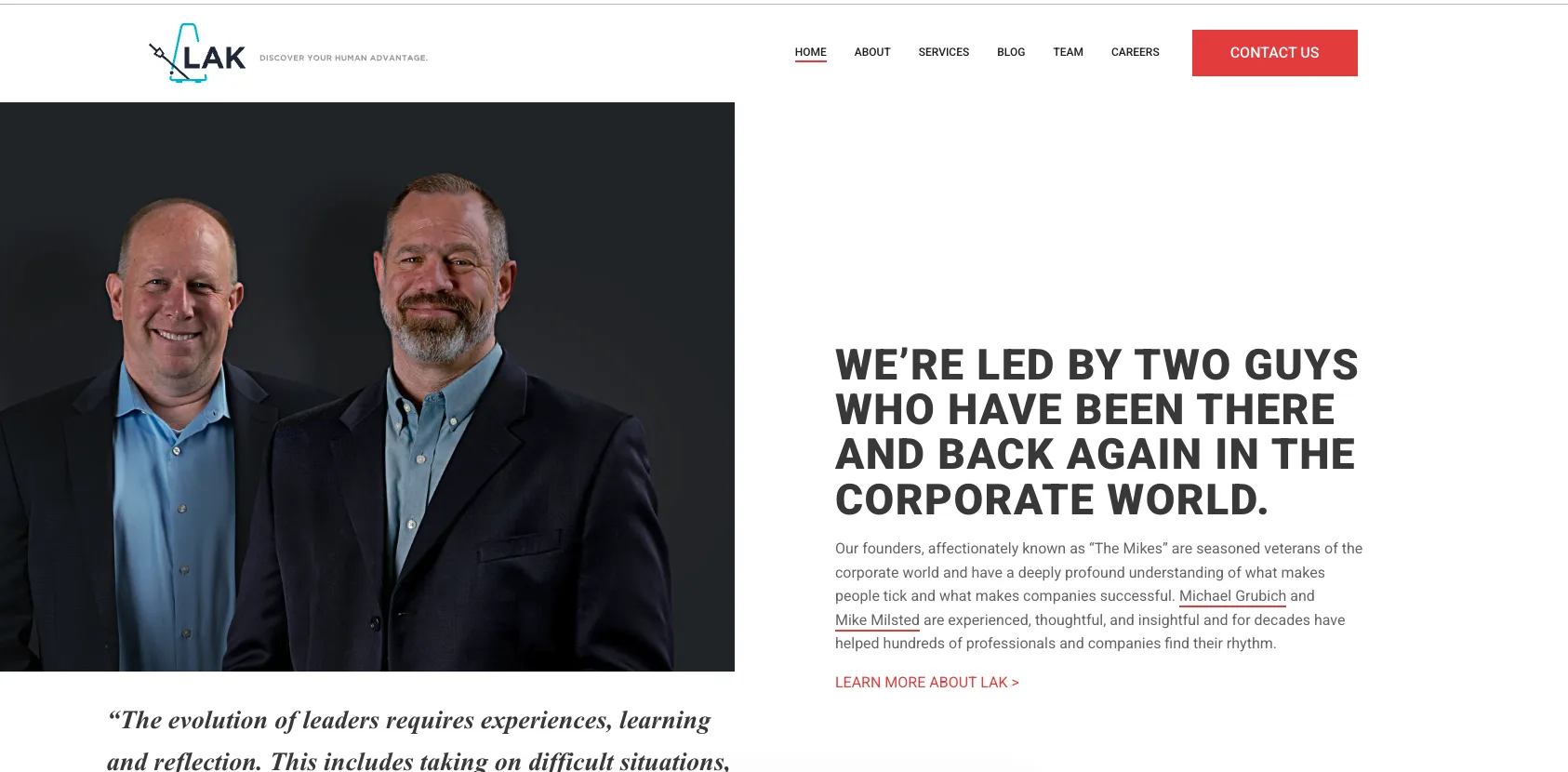
LAK Group is a US human capital firm working across the full talent lifecycle: assessment, hiring, leadership development, coaching, succession, and outplacement. Culture shaping sits inside that, which is both the argument for using them and the reason they are the odd name on this list. Every other firm here sells culture work as its own product.
What LAK Group does well
The work starts from your business objectives rather than a model. LAK’s stated position is that culture shaping begins with objectives linked to your business strategy, and the five-step process is fitted to those. Define the gap between the culture you have and the one the strategy needs. Unify by setting explicit behavioral expectations for leaders. Activate through experiential education for leaders and teams. Integrate the change into talent and business processes. Sustain it by measuring progress, reinforcing the behaviors, and holding people accountable.
Leaders change first, and that is the whole mechanism. The work is built around what leaders do differently on Monday morning, not around a values statement or a communications campaign. In a multi-site health system, LAK ran culture activation workshops for every leader, supported them with group coaching, and tracked each leader’s progress on a culture scorecard through the engagement. The health system reported an 8% reduction in clinical caregiver turnover, alongside stronger caregiver engagement and better communication between leaders and their teams.
Culture is not a standalone project. The same firm also runs your executive coaching, your assessment work, and your succession planning, so the behavioral expectations set during the culture work get written into how you select, develop, and promote leaders. Those decisions are what reinstall the old culture when they are left alone.
The people delivering it have run organizations. LAK’s consultants and coaches have held senior line roles, so a leadership team being asked to operate differently is hearing it from someone who has carried the same numbers. The firm is also built for mid-sized organizations, which is the client the global culture practices are not designed around.
Where LAK Group falls short
The measurement is thinner than the field’s. LAK uses a culture scorecard but publishes no instrument, no validation study, and no benchmark data, so you cannot see where you stand against comparable organizations. That is a trade-off rather than an oversight. Gallup and Korn Ferry own their instruments and sell you both the instrument and the comparison, while LAK selects the tools and owns what gets done with the result.
The work reaches employees through their leaders. If your problem is that you need something visible in front of 5,000 people next quarter, a platform does that and LAK does not. LAK changes the leadership tier and lets that flow down, which is slower and reaches employees second-hand.
Best for
A mid-sized organization that needs its leaders to behave differently, and wants that change written into how it hires, develops, and promotes people rather than delivered as a standalone program.
2. Heidrick & Struggles
Heidrick & Struggles is a global executive advisory firm with more than $400 million in revenue, over 2,000 people, and offices in more than 50 countries. Its culture practice is Senn Delaney, founded in 1978 and acquired by Heidrick at the end of 2012. Its founder, Dr. Larry Senn, is widely described as the father of corporate culture.
What Heidrick & Struggles does well
Heidrick makes the same argument LAK makes, and it made it first. Its published position is that culture is shaped by the leadership shadow, meaning how leaders actually behave in the workplace every day, and that the work does not succeed unless the CEO owns it. This is a genuine strength. On the question of tying culture to leadership behavior, Heidrick answers it as well as anyone on this list, LAK included, and it has been answering it that way since 1978.
The engagement runs on five priorities: create the case for change, set compelling direction, mobilize with total commitment, unlock every team, and rig for execution. Heidrick publishes client outcomes against them. One global retail client reported 97% colleague alignment to purpose, operating profit growth of 12.8% year on year, a 43% share price increase, and £1 billion of cost savings delivered a year ahead of schedule. A global luxury automaker reported a 1.5x cost performance improvement and a 60% increase in on-time delivery. For a large company whose board is watching the culture program, that combination of history and publishable results is the reason to call.
Where Heidrick & Struggles falls short
The premium is steep, often two to three times what a boutique or a mid-market firm charges, and the model is built around large global corporations. Below the C-suite the firm is a harder fit and an expensive one, so the mid-level leaders where most of your culture is actually experienced are the hardest layer to reach affordably.
Heidrick is also a search firm first. Executive search is the larger business, and culture consulting sits alongside it rather than at the center of the firm. No pricing is published, and the published outcomes are large-enterprise case studies, so there is little to compare against if your organization is a tenth of that size.
Best for
A large company running culture change from the CEO down, where board-level credibility and a long track record matter more than cost.
3. Korn Ferry
Korn Ferry is one of the largest talent firms in the world, with more than $2 billion in revenue, 8,600-plus employees, and offices in over 50 countries. Culture sits inside its organization strategy practice, next to executive search, assessment, leadership development, and rewards.
What Korn Ferry does well
Korn Ferry does excellent research, and its diagnostics are widely respected by HR teams that have to justify a decision internally. Its Organizational Culture Assessment is built on more than a decade of the firm’s own primary research, and it produces a baseline you can track over time. The output is sorted into culture keeps and culture shifts, which is a genuinely useful way to stop a culture program from throwing out the parts of the organization that already work.
The connection to the rest of the talent system is real. Korn Ferry ties culture change to capability models, succession plans, and organizational design, so the new behaviors show up in how people are assessed and promoted. The firm also publishes the executive research that gets culture programs funded: 91% of executives agree improving corporate culture would increase their organization’s value, and 80% rank culture among the five most important factors driving valuation.
Where Korn Ferry falls short
Culture is one capability among many rather than the whole business. Engagements can feel templated and process-heavy, and the senior partners who sell the work are often not the people who run it, so delivery can sit with more junior consultants than the pitch implied.
Pricing is built for the Fortune 1000. For a mid-sized organization the fee buys a scale of apparatus you will not use, and the return per leader is hard to see. No pricing is published.
Best for
A large enterprise changing culture alongside a restructure or a succession program, that wants one global brand across search, assessment, and culture.
4. Gallup
Gallup is a global analytics and workplace advisory firm with more than 90 years of data collection behind it and over 4,000 organizations on its workplace performance platform. Its culture products are the Q12 engagement survey, the Gallup Access platform, CliftonStrengths, and manager development.
What Gallup does well
Nobody measures a culture better. The Q12 is a 12-item engagement survey validated through meta-analysis across millions of responses and thousands of business units, and Gallup publishes what the top quartile looks like against the bottom: 23% higher profitability, 18% higher productivity, 78% lower absenteeism, and 21% lower turnover. That is the strongest published link between a culture measure and business results that any firm on this list can point to.
The benchmark is the part nobody else can copy. Because the same instrument has run across thousands of organizations, Gallup can tell you not just what your score is but where it sits against comparable employers. If your board asks whether a 3.9 is good, Gallup is the only firm here that answers with a number rather than an opinion.
Where Gallup falls short
Gallup publishes the limitation itself, which is the fairest way to state it. Its own article is titled “Surveys Alone Won’t Improve Employee Engagement”, it says companies pay too much attention to measurement and not enough to creating real change, and a companion piece states that “An annual survey by itself does not help anyone.” The same piece notes that engagement has sat at roughly a third of employees in the US and around 15% globally since 2000, through two decades of engagement programs. Buying the measurement is not buying the change, and Gallup is clear about that.
The delivery model is also worth understanding before you sign. Gallup’s strengths coaching reaches clients through an external directory of certified coaches rather than an in-house bench, so the person doing the follow-up work is often not a Gallup employee. And Gallup does not offer executive search, succession execution, or transition services, so a culture finding cannot be handed to the same firm to act on.
Best for
An organization that needs a validated read on where its culture stands and a benchmark to compare against, and has the internal leadership capacity to act on what the data says.
5. Culture Partners
Culture Partners is a dedicated culture consultancy, formerly Partners in Leadership, with estimated revenue of $50 to $100 million and a mid-sized consulting bench working primarily in North America. It is the only firm on this list whose entire business is culture.
What Culture Partners does well
The methodology is clear and it is the same one every time. The Results Pyramid, built on the accountability principles of the bestseller The Oz Principle, holds that the experiences you create shape what people believe, beliefs drive what people do, and actions produce results. Work starts with a survey that scores all four layers, so you can see which one is stalling performance. The firm’s own research, drawn from 4,960 employee survey responses across 26 global organizations over three years, states that activating those four factors improves overall culture strength by 62%.
Culture Partners is strongest on the part most firms are weakest on, which is what happens afterward. Consultants redesign the routine touchpoints a team already runs on, such as shift handoffs and customer callbacks, so the new behavior lives inside existing habits rather than in a separate program. Quarterly culture reviews keep it on the agenda. Named clients include Marriott International, Southwest Airlines, and Ford.
Where Culture Partners falls short
Culture Partners does culture and nothing else. There is no assessment practice, no executive search, no succession execution, and no transition support, so the work stops at the edge of the decisions that set your culture in the first place. Whoever you hire and promote next year is somebody else’s process.
Everything also runs through one proprietary model. The Results Pyramid is well tested, and it is what you are buying, so if your situation does not fit its accountability framing you are fitting yourself to the method. Brand recognition is limited against the global firms, the footprint is heavily US, and no pricing is published.
Best for
A company that wants a dedicated culture firm with one clear methodology and quarterly reinforcement, and already has its hiring, assessment, and succession processes handled elsewhere.
6. Workhuman
Workhuman is not a consulting firm. It is an employee recognition platform, with estimated revenue over $300 million and more than 800 staff. It is on this list because it competes for the same budget and the same problem, and because for a large employer it is a genuine alternative to hiring consultants.
What Workhuman does well
Workhuman reaches everybody, which no consulting engagement does. As of March 2026 the platform states 8 million users across more than 180 countries and over 100 million moments of recognition delivered, with users spending more than $1 billion a year through its reward marketplace. A consulting engagement works on a leadership team. Workhuman works on every employee, every day.
The published outcome data is specific. Workhuman reports that 54% of employees increased their performance rating after receiving three or more awards, that employees receiving three awards a year show 66% lower turnover, and that recognized employees are five times more likely to stay through their first year. If your retention problem is concentrated in the first year, that is a directly relevant number.
Where Workhuman falls short
Recognition is one lever, and it is downstream of the things a culture engagement works on. The platform does not diagnose your culture against your strategy, does not set behavioral expectations for your leaders, and does not change how a leadership team operates. It makes good behavior more visible, which is valuable and is not the same as changing what leaders do.
Buyers also flag the economics. Reviewers on G2 report that catalog items are priced above comparable retail and that the points-to-value conversion is unclear, that the range of useful reward options is narrower than promised, and that the platform can be heavy in both cost and complexity for smaller or less mature organizations. No pricing is published.
Best for
A large employer that wants continuous, visible recognition at every-employee scale, and already has leadership behavior handled somewhere else.
Which culture consulting firm is right for you?
If your CEO is leading the culture change personally and the board is watching, Heidrick & Struggles has been doing exactly that work since 1978, and it has the published client results to put in front of a board.
If the culture change is part of a restructure, a merger, or a succession program, Korn Ferry can run the diagnostic and tie the result to capability models and succession plans under one global brand.
If what you actually need is to find out where you stand, Gallup measures a culture better than anyone here and can tell you how your numbers compare to thousands of other employers. Budget separately for what you do about it.
If you want one dedicated culture firm with a single tested methodology and quarterly reinforcement, Culture Partners does culture and nothing else, and is unusually good at making the change stick inside daily routines.
If you need something in front of every employee quickly, Workhuman reaches 8 million people daily and publishes retention numbers to back it, as long as you are clear that recognition is a lever and not a strategy.
And if you are a mid-sized organization whose leaders need to behave differently, LAK Group is the firm built for that: the work starts from your business objectives, changes what leaders do, and gets written into how you hire, develop, and promote people so the old culture stops being reinstalled every quarter. If that is the problem you have, book a conversation with LAK Group about what your leaders do today and what needs to be different.
FAQs
What does a culture consulting firm actually do?
A culture consulting firm changes how people in your organization behave day to day. In practice that means four things: measuring the culture you have, defining the culture your strategy needs, changing how your leaders act so employees experience something different, and building reinforcement so the change holds. Some firms sell all four, some sell only the measurement, and some sell only the reinforcement. The common mistake is buying one and expecting the other three.
How much does culture consulting cost?
None of the six publish a price for culture work, so you get a quote after the scope is defined. Cost tracks two things: how many leaders are in the work, and how long the reinforcement runs. A global advisory firm carries a cost base built around Fortune 500 programs and prices accordingly, often two to three times a mid-market firm. Platforms are priced per employee per year, which looks cheaper per head and scales with your headcount rather than with the size of your problem.
How long does a culture change engagement take?
Longer than the workshops. Delivery ranges widely across these firms, from a one-hour keynote to multi-year programs, but the useful question is how long the reinforcement lasts, not how long the sessions run. Behavior fades when the quarter gets hard, so what determines whether anything is different a year later is what is still running after the engagement ends: measurement, routines, and the talent processes the new expectations are written into.
Is an employee engagement survey enough to change culture?
No, and the firm that sells the best-known survey says so. Gallup publishes that companies pay too much attention to measurement and not enough to creating real change, and states plainly that an annual survey by itself does not help anyone. Its own data shows engagement stuck at roughly a third of US employees and around 15% globally since 2000, through two decades of surveying. A survey tells you where you stand. Changing what your leaders do is a separate piece of work with a separate budget.
Which culture consulting firm is best for a mid-sized company?
The global advisory firms are priced and scoped for much larger clients, and the platforms are built for headcount rather than for leadership change. LAK Group is built for mid-sized organizations and starts from your business objectives rather than a fixed model, then connects the culture work to assessment, coaching, development, and succession so the change reaches the decisions that set your culture. If your leadership team is the thing that needs to change, that connection matters more than a global brand name.