

Most business coaching is built to fix one person. You, the owner. The premise is that the company is stuck because you are the bottleneck, and once you delegate, build systems, and get out of the day-to-day, growth follows. For a founder still doing everything, that premise is often right, and a good coach who has run a company can be worth every dollar.
It stops being the whole story the moment you hire a leadership team. Once you have a head of sales, an operations lead, and a finance person who make real decisions, coaching only the owner leaves the people who actually run the company undeveloped. The question changes from “how do I get out of the way” to “how do I make the five people below me better,” and most business coaching services are not built to answer the second one.
So the services below split into two groups. Some coach the owner and stop there. Some can reach the whole leadership team and connect the coaching to hiring, development, and succession. We compare five business coaching services on seven criteria that decide which group a provider is really in. Here is how they compare.
| Criteria | LAK Group | Vistage | CEO Coaching International | ActionCOACH | EMyth |
|---|---|---|---|---|---|
| Who delivers the work | Practitioners who have held senior line roles, matched on chemistry and fit | A local Chair, usually a former executive, plus a peer group | A dedicated coach, most are former CEOs or founders | A local franchise owner trained in the ActionCOACH system | A certified EMyth Coach assigned to your account |
| Whether the coach has run a business | Yes, senior operating roles required before coaching | Usually, Chairs are vetted former leaders | Yes, most coaches led companies to exits | Varies by franchisee, no operating floor published | Varies by coach, framework matters more than résumé |
| Adapted to your situation or a standard program | Scoped per engagement, no fixed curriculum | Structured monthly agenda across the peer network | The Make BIG Happen system, applied to your numbers | A proven, standardized global coaching system | A fixed systems-first framework from the E-Myth method |
| Session cadence and format | Set in the engagement, one-to-one plus platform | One full day a month in a group, plus 1:1 time | Twice-monthly one-to-one calls, structured | Weekly or biweekly one-to-one, local and virtual | One-to-one sessions on a monthly retainer |
| Fit and cost for a smaller business | Built for the mid-market, quote-based, no minimum | Membership dues, priced for established-company CEOs | Premium retainer aimed at growth-stage CEOs | Local franchise pricing, accessible entry point | Publishes its pricing openly, tiers by team size |
| How it connects to the rest of your talent strategy | One firm across coaching, assessment, development, succession | CEO development only, no organizational services | CEO and executive growth, no talent stack | Owner and small-team coaching, no talent services | Owner systems and leadership team, no wider stack |
| How results are measured | Against engagement goals, no published metric | Members grow 2.2x faster than non-members (2017 D&B) | Client revenue CAGR 22.8%, EBITDA CAGR 37.5% at 2+ years | Business growth and profit gains, reported per client | Owner-dependence reduced, reported per engagement |
Figures reflect what each provider published. Where pricing is not published it has to be requested, so confirm every number against your own quote.
What to look for in a business coaching service
Seven questions separate these services once you get past the sales page. Each one changes what you actually get for the money, and each one is worth asking before you sign.
- Who actually coaches you, and what they ran. Business coaching only works if the person across the table has carried the weight you are carrying. Ask what the coach did before they coached. Someone who has run a company through a cash crunch can tell you how the decision in front of you usually goes. Someone certified in a method will ask good questions about it. You want to know which one you are getting.
- Whether it is built around your business or around a system. Some services run every client through the same steps because the steps are the product. That is not a criticism, and for an owner who has never built a process it can be exactly right. Ask what changes between your engagement and the last client’s. If the honest answer is “the same framework, different homework,” you are buying a program, not a plan for your company.
- How often you meet, and in what format. A monthly peer day, a twice-a-month call, and a weekly working session are three different products at three different prices. More contact is not automatically better, but it decides how much of the work happens with the coach in the room and how much lands on you between sessions. Ask what the cadence is before you compare fees.
- Whether it reaches past you. This is the question that sorts the field. If your company has a leadership team, ask whether the service can coach them too, and what that costs. A service built to coach one owner can rarely coach five leaders well, and the growth you are chasing usually depends on those five more than on you.
- What it costs a business your size. Franchise and retainer models publish very different numbers, and the cheapest headline is not always the cheapest outcome. Ask for the all-in annual cost, including anything beyond the owner, and compare cost per leader developed rather than cost per session. A low monthly rate that only touches you can cost more per result than a higher one that reaches the team.
- How it connects to the rest of your talent work. Coaching teaches a provider more about how your leaders think than almost any other engagement. If the same firm also runs your assessments and helps with succession, that knowledge can inform who you promote and who you hire next. If coaching sits on its own with a separate provider, it usually stays in the room and never reaches those decisions.
- What the provider will show you at twelve months. Ask what a good outcome looks like on paper. Some services point at revenue and profit growth across their client base, which is useful and worth weighing. Others report against the goals you set together. Decide which proof you need before the pitch, because a headline growth number across other companies is not a promise about yours.
Two of these seven questions decide most of the choice: whether the coach has actually run a business, and whether the coaching reaches past you into the leadership team. The franchise and peer models win on accessibility and on a track record of published growth numbers, and for a solo owner who needs to get out of the day-to-day they are a strong, affordable start.
The services that can develop a whole leadership team are a shorter list, and they cost more because they do more. We start with the one built for the company rather than the owner, then work through the four built mainly for the person at the top.
1. LAK Group
LAK Group is a US human-capital firm that works across the full talent lifecycle, from assessment and hiring through coaching, development, succession, and transition. Its business coaching sits inside that rather than beside it, which is what separates it from the owner-focused services here. It is built for a company that has grown past the founder, not for the founder alone.
What LAK Group does well
The coaching reaches the whole leadership team, not just the owner. LAK coaches the CEO, and it coaches the head of sales, the operations lead, and the finance chief in the same engagement, on the same platform. Coaching On Demand extends the same coach bench down to directors and managers, so the layer that turns your strategy into daily work gets developed too. Most services here can coach one person well and stop there.
Coaching comes from people who have run businesses. LAK staffs the practice with practitioners who have held senior line roles rather than career coaches, and matches coach to leader on chemistry and fit rather than assigning from a queue. When your operations lead is deciding whether to restructure a plant, the coach has usually made that call themselves.
Engagements are scoped, not packaged. There is no fixed curriculum and no system every client runs through, so a founder handing off day-to-day control gets different work from a new COO learning to lead peers. ORIEL, LAK’s AI coaching platform, carries the work between sessions: a leader can rehearse a board update or a hard conversation and get feedback on it before the meeting, not after.
LAK connects coaching to the rest of your talent work. The same firm runs assessment, leadership development, and succession, with one point of accountability, so what surfaces in coaching can inform who you promote and where the next hire needs to be stronger.
Where LAK Group falls short
LAK publishes no growth metric across its client base. CEO Coaching International publishes an average client revenue growth rate of 22.8% a year at two years or more, and Vistage publishes that members grow 2.2 times faster than non-members. LAK reports against the goals set inside your engagement, which is the more useful measure once you are a client and the less useful one while you are choosing. Ask for references at your size and ask what those clients measured.
LAK is not the cheapest way to start. EMyth publishes its pricing openly, and a local ActionCOACH franchise is often a more affordable place to start for a business with no leadership team yet. LAK is built for the mid-market and scopes to a conversation about your leadership population rather than a number on a page, so a very small business without a team to develop may be paying for reach it does not need yet.
It is not a CEO peer network. If what you want is a room of other owners who have faced your exact decision, Vistage does that in a way a coaching firm does not. LAK coaches your leaders and builds your bench; it does not put you in a monthly group of your peers.
Best for
Growing companies that have a leadership team, not just an owner, and want coaching that develops all of them, comes from people who have run businesses, and connects to assessment and succession rather than sitting on its own.
2. Vistage
Vistage is the world’s largest CEO peer-advisory organization, with tens of thousands of members. Each member joins a local group of roughly a dozen non-competing CEOs that meets one full day a month, led by a “Chair” who is usually a former executive and who also coaches members one-to-one between meetings. It is coaching wrapped around a peer network rather than a coaching firm.
What Vistage does well
The peer group is the product, and it is hard to replicate. Sitting in a room of other CEOs who have made the decision in front of you gives an owner something no single coach can: a dozen people who have run companies and have no stake in telling you what you want to hear. For an isolated founder, that accountability is genuinely valuable.
The Chairs are experienced operators. Vistage vets its Chairs as former senior leaders, so the person running your group and coaching you privately has usually carried real business responsibility. The published track record is strong: Vistage cites 2017 Dun & Bradstreet data showing member companies grow 2.2 times faster than non-members.
The model has staying power. Vistage reports that member companies stay in business far longer than the US average, which fits what the peer structure is built to do: keep a CEO accountable to people who will notice if the numbers slip.
Where Vistage falls short
It coaches the CEO and no one else. Vistage develops the person at the top and has no way to reach your leadership team, run your assessments, or support succession. If your growth depends on the five leaders below you, this model does not touch them.
Chair quality varies by location. You are matched to whoever runs the group in your area, and the experience depends heavily on that person. Ask to meet your prospective Chair before joining, and ask how long they have run the group.
The peer-day format does not suit everyone. A full day a month away from the business, sharing openly with a room of other owners, is a real commitment and not every leader works well that way. It is a schedule and a style as much as a service.
Best for
CEOs and owners who want peer accountability and a private coach in one membership, and whose main need is their own development rather than the development of a leadership team.
3. CEO Coaching International
CEO Coaching International is a one-to-one coaching firm for CEOs, founders, and entrepreneurs, built around a method it calls Make BIG Happen. It reports having coached more than 2,000 leaders across 90-plus countries, and staffs its bench with coaches who are former CEOs, presidents, and founders, many of whom led their own companies through large exits.
What CEO Coaching International does well
The coaches have sat in the chair. This is the firm’s central claim and a real one: your coach is usually someone who has run and often sold a company, so the advice comes from experience rather than theory. For a growth-stage CEO chasing a specific number, that operating background is the draw.
The results it publishes are specific and financial. CEO Coaching International reports that clients engaged for at least two years achieve an average revenue growth rate of 22.8% a year and an average EBITDA growth rate of 37.5%, which it benchmarks at roughly two and three times US averages. Few coaching providers attach numbers this concrete to their work.
The method is structured around outcomes. Make BIG Happen sets goals against your own metrics and works them through twice-monthly sessions, so the coaching stays anchored to revenue, profit, and the milestones that move them rather than to general development.
Where CEO Coaching International falls short
It coaches the leader, not the organization. Like Vistage, this is a service for the person at the top. It does not develop your leadership team, run assessments, or connect to succession, so the knowledge your coach builds about you stays with you.
The published growth numbers describe other companies. An average revenue growth rate across the client base is a strong signal, but it is not a forecast for your business, and the firm is candid that results depend on the CEO. Treat the figures as a track record, not a promise, and ask what a realistic first-year goal looks like for a company your size.
The positioning is premium and growth-focused. This is built for ambitious CEOs pursuing outsized growth, which is not every owner’s goal. If you want steady, sustainable improvement rather than a run at a big number, the intensity may not fit.
Best for
Growth-minded CEOs and founders who want a one-to-one coach who has run and exited a company, and who are chasing an aggressive revenue or profit target they can name.
4. ActionCOACH
ActionCOACH is a business coaching franchise founded in 1993, with a network of more than 1,000 coaches worldwide who deliver a standardized coaching system to small and mid-sized business owners. You are coached by the local franchise owner in your area, trained and licensed in the ActionCOACH method.
What ActionCOACH does well
The system is proven and consistent. ActionCOACH has refined the same coaching framework across three decades and a thousand-plus coaches, so an owner who has never built a sales process or a set of financial controls gets a tested, step-by-step path rather than a blank page. For a first-time owner, that structure is the value.
It is local and accessible. Because delivery runs through local franchisees, an owner gets a coach in their own market at a price point built for small business, often with weekly or biweekly contact. That cadence and proximity suit an owner who wants regular, hands-on accountability.
It reports business growth per client. ActionCOACH coaches work toward concrete gains in revenue, profit, and the owner’s time, and franchisees publish client results locally, so you can usually ask a prospective coach for outcomes from businesses like yours in your area.
Where ActionCOACH falls short
Coach quality depends on the franchisee. The system is standardized, but the person delivering it is a local business owner whose own operating background varies. There is no published floor for what a franchisee ran before coaching, so ask your prospective coach directly what they have built and led.
It is built for the owner and the small team. ActionCOACH is strong for an owner-operator and a handful of staff, and thinner once you have a full leadership team that needs developing as individuals. It coaches the business through the owner rather than coaching your executives directly.
There is no wider talent stack. ActionCOACH coaches; it does not run leadership assessments, build succession plans, or handle senior hiring, so nothing that surfaces in coaching feeds those decisions unless you carry it there yourself.
Best for
Owner-operators of small and early-stage businesses who want an affordable local coach and a proven, structured system for building the basics of a company that runs without them.
5. EMyth
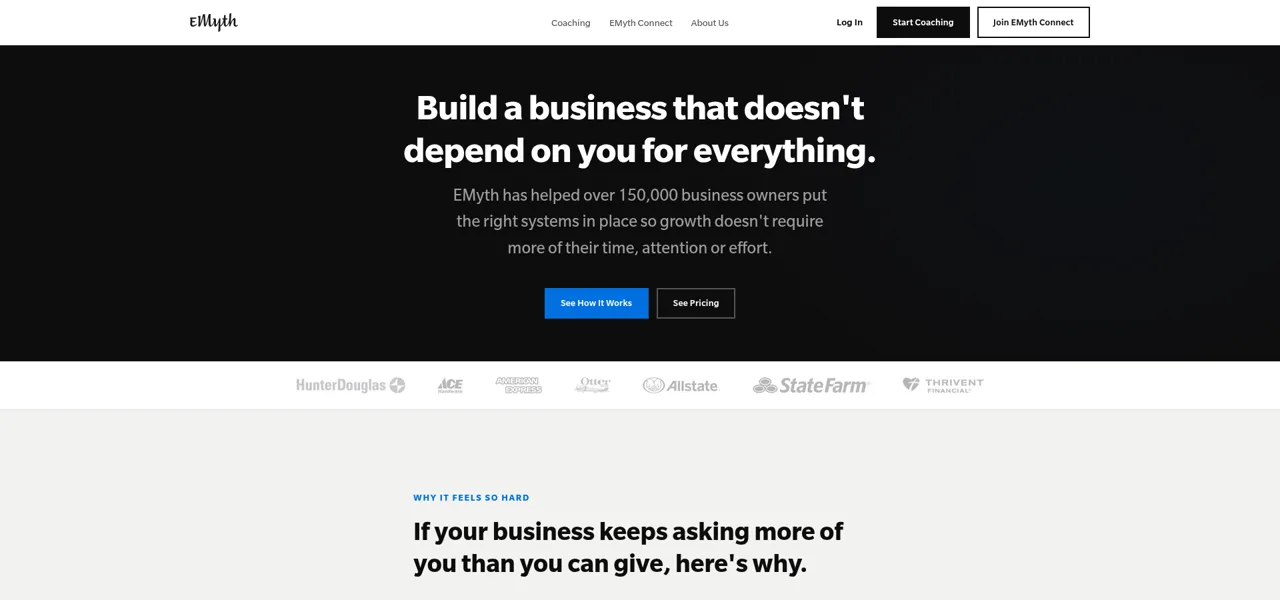
EMyth built its coaching on Michael Gerber’s book The E-Myth, and the whole method aims at one outcome: a business that runs without depending on the owner for everything. A Certified EMyth Coach works with you one-to-one on a monthly retainer to turn how you do things into systems your team can follow. EMyth publishes its pricing openly, with a standard coaching tier and a higher tier that extends to your leadership team.
What EMyth does well
The pricing is transparent, which is rare here. EMyth publishes its rates on its site, so you can compare it against your budget without a sales call. For an owner who wants to know the number before the conversation, that openness is a real advantage over the quote-on-request model most of this list uses.
The framework is clear and systems-first. EMyth diagnoses where the business depends on the owner and builds the processes, standards, and roles that remove that dependence. For a founder who is the bottleneck for every decision, that is a focused, well-worn path to getting the business off their shoulders.
There is a route to the leadership team. The higher-priced executive tier extends coaching to you and your leadership team rather than only the owner, so EMyth can reach past the founder further than a pure owner-coaching model, within the limits of its framework.
Where EMyth falls short
The method is fixed. EMyth runs its systems-first framework with every client, so a leader whose challenge is influence, board dynamics, or a specific strategic call rather than operational systems may find the approach pointed at the wrong problem. Ask whether your actual challenge is the one the framework is built to solve.
Coaching depth varies by coach. EMyth matches you with a Certified EMyth Coach, and the certification is in the method rather than in senior operating experience. For a company past the systems-building stage, ask what the coach ran before, not just which framework they hold.
There is no assessment or succession layer. EMyth coaches the owner and the team on running the business; it does not run leadership assessments, plan succession, or support senior hiring, so it stays inside the coaching relationship rather than connecting to the rest of your talent decisions.
Best for
Owners of small and mid-sized businesses who know the company depends too heavily on them, want a clear systems-first method, and value published, predictable pricing.
Which business coaching service is right for you?
Vistage fits a CEO who wants a room of peers and a private coach in one membership, and whose main development need is their own. CEO Coaching International suits a growth-minded founder chasing a specific revenue or profit target who wants a coach that has run and sold a company. ActionCOACH is the accessible local start for an owner-operator building the basics of a business that runs without them. EMyth fits an owner who is the bottleneck, wants a systems-first method, and values knowing the price up front.
The choice narrows the moment your company is more than its owner. If you have a leadership team whose decisions drive your growth, a service that only coaches the person at the top leaves your biggest source of growth untouched. LAK Group coaches the whole team on one platform, staffs the work with people who have held senior operating roles, scopes each engagement instead of running you through a system, and extends coaching down to the directors and managers who turn strategy into work through Coaching On Demand. Assessment, development, and succession sit with the same firm, so what coaching surfaces reaches the decisions about who leads next. Talk to LAK Group to scope it for your leadership team.
FAQs
What is the difference between business coaching and executive coaching?
Business coaching usually centers on the company and the owner: growth, profit, systems, and getting the founder out of the day-to-day. Executive coaching centers on an individual leader’s effectiveness, decisions, and influence, and is often bought for senior leaders across a company rather than only the owner. The two overlap, and several providers do both. Confirm which one a proposal actually covers, because the reader it is built for changes the work.
How much do business coaching services cost?
Cost ranges widely by model. EMyth publishes its rates openly on its site. Franchise coaching through a network like ActionCOACH is priced locally and is often a lower entry point. Peer-and-coach memberships and premium one-to-one CEO coaching run higher and usually quote on request, as LAK Group does. Compare the all-in annual cost and how many people the service actually develops, not just the monthly headline.
Can business coaching develop my whole leadership team, not just me?
Only some services can. Owner-focused coaching and CEO peer models are built around one person and rarely reach the leadership team well. If developing your leaders is the goal, look for a provider that coaches multiple people in one engagement and can extend to directors and managers. LAK Group coaches the leadership team on one platform and reaches the layer below through Coaching On Demand, and EMyth’s executive tier extends past the owner within its framework.
How do I measure the return on business coaching?
Decide what you will measure before the engagement starts. Some providers publish growth numbers across their client base, such as CEO Coaching International’s average client revenue growth rate of 22.8% a year at two years or more, and Vistage’s finding that members grow 2.2 times faster than non-members. Those are track records across other companies, not forecasts for yours. The measures worth writing into your own plan are the specific business outcomes you are hiring the coach to move and, if the coaching reaches your team, retention and readiness among the leaders who were coached.
Should a small business hire a coach or join a peer group?
It depends on what is missing. A peer group like Vistage gives an isolated owner a dozen other CEOs and shared accountability, which is right when the gap is perspective and honest challenge. A one-to-one coach gives focused, private work on your specific situation, which is right when the gap is a particular problem or capability. Many owners do both at different stages, and some services combine them. If your company has a leadership team to develop, weigh a firm that can coach them too rather than only you.