

A 360 feedback tool sells you a questionnaire about how a leader behaves at work. The tool sends it to the people around the leader, called raters: their manager, their peers, and the people who report to them. It keeps each rater’s answers anonymous, then produces a report that sets the leader’s view of themselves next to everyone else’s. Most tools sell all of that for a modest price per leader, and you can often launch in an afternoon.
Look at what the price does not cover. Nobody sits down with the leader to explain which scores matter. Nobody turns the report into a development plan or coaches the leader through it. And nobody runs the 360 again a year later to check whether the raters see a difference. Those jobs land on an already stretched HR team, so the leader reads the report once, feels stung by two comments, and files it.
On survey design, rater anonymity, clean reports, and links to your HR systems, the leading tools are all strong, and the gaps between them are small. The bigger difference is whether anyone picks up the report after it lands. We set six providers side by side below, from self-serve software to firms that debrief and coach the leader themselves.
| Criteria | LAK Group | CCL | Korn Ferry | Hogan | Culture Amp | Spidergap |
|---|---|---|---|---|---|---|
| Validation and question design | Research-based instruments chosen for each engagement, plus interviews | 50+ years of research; executive-only comparison group available | Built on the Korn Ferry Leadership Architect competency model | Benchmarks by industry and job level; items revised in 2024 | Templates grounded in coaching and motivational science research | Best-practice template that you can fully customize |
| How rater feedback is gathered and kept confidential | Interviews plus anonymous ratings, debriefed by a LAK consultant | Benchmarks by Design data released only to qualified facilitators | Confidential survey run by practitioners trained in KF360 | Ratings by rater group, plus personalized rater comments | No minimum group size, so a lone rater can be identified | Optional anonymity; a manager approves the rater list first |
| Integrations and admin overhead | No software to integrate; LAK’s team runs the process | Online administration, with the CCL Compass planning tool included | Runs on Korn Ferry Assess, alongside its other assessments | Delivered online through Hogan’s network of authorized partners | HRIS, Slack, and Microsoft Teams integrations on every plan | Self-serve setup, raters need no login, single sign-on on Pro |
| What it costs, and whether the price is published | Quoted per engagement; no price published as of October 2026 | $380 per manager, $425 per executive, before facilitation | Requires an assessment-center contract; no price published | No 360 price published; sold through authorized partners | Annual quote by headcount and product; no price published | $1,099 a year for 10 leaders, then $89 each |
| Who supports the debrief | LAK consultants deliver the feedback to the leader directly | A CCL-certified facilitator; certification costs $2,500 per person | KF360-certified practitioners, your own or Korn Ferry’s | A Hogan partner or your own certified practitioner | The leader’s manager, assigned as their Coach in the platform | Optional; the report goes to the leader as a PDF |
| What happens after the report | Development plan, then coaching and ORIEL practice from LAK | CCL Compass goal planning; CCL coaching bought separately | Development planning, plus Korn Ferry coaching contracted separately | Development priorities in the report; coaching comes through partners | Development plans, goals, and 1-on-1s inside the platform | Personal development plan template included in every report |
| How results are measured | Baseline assessment, coaching, re-assessment, then business measures like turnover | Compass tracks goals; you schedule and pay for any repeat 360 | Individual and group reports; repeat rounds contracted separately | Self-versus-rater gaps compared with global manager benchmarks | Repeat round recommended every four to six months | Repeat rounds for the same leader within a 12-month license |
| How it connects to the rest of your talent strategy | Same firm runs coaching, development, succession, recruiting, and outplacement | Leadership programs, coaching, and a succession program; no executive search | Search, succession, coaching, and consulting inside one global firm | Assessment only; everything else runs through Hogan’s partners | Engagement surveys, performance reviews, and goals in one platform | Dedicated 360 tool with no wider talent services |
Figures reflect what each provider published as of October 2026. Where a price is not published it has to be requested, so confirm every number against your own quote.
What to look for in a 360 feedback tool
Eight questions separate these providers. Four, from validation to price, are about the tool itself. The other four cover what the tool leaves out.
- Validation and question design. A validated questionnaire has been tested to show it measures what it claims, and gives similar results when the same leader is rated twice. The best instruments also compare each leader with a norm group, meaning a large set of leaders in similar roles. Without one, a leader cannot tell whether a middling score is normal for their level or a real problem.
- How rater feedback is gathered and kept confidential. Raters only tell the truth if their answers cannot be traced back to them. Ask how many raters a group needs before its scores are shown, and who sees the raw answers. If a leader’s one direct report can be identified, the next round of feedback will be politer and less useful.
- Integrations and admin overhead. Somebody has to load the leaders, chase the raters, and release the reports. Ask how much the tool automates and whether it connects to your HR system, because across a 200-person rollout that is real hours.
- What it costs, and whether the price is published. Prices range from a flat annual fee to per-person instrument fees plus a separate charge for whoever explains the results. Ask for the all-in cost per leader, including any certification your staff would need. A low survey price can double once you add the debrief.
- Who supports the debrief. The debrief is the conversation where someone helps the leader read the report and pick out the two findings that matter. Ask who runs it, how they were trained, and whether it is in the price. A leader who reads a critical report alone is more likely to reject it than act on it.
- What happens after the report. A 360 tells a leader what to change but changes nothing by itself. Ask whether the provider turns the findings into a development plan, and whether the same firm can coach the leader through it.
- How results are measured. Ask how the provider checks whether the leader actually changed: whether the same raters are asked again, after how long, and what business results are tracked alongside. Without a second measurement, you cannot show your CFO whether the money did anything.
- How it connects to the rest of your talent strategy. Ask whether the 360 reaches your promotion and succession decisions, or stays in a system the decision-makers never open.
The software tools win on two of these eight questions. Culture Amp connects to the HR systems you already run, and Spidergap is the cheapest and fastest way to start, at a published price. CCL wins on validation and question design, because nobody else here matches its research record. Korn Ferry and Hogan sit between the software and CCL, with research-based instruments sold through certified practitioners.
LAK Group leads on the four questions about what the tool leaves out: the debrief, what happens after the report, how results are measured, and how the 360 connects to your talent strategy. It also shares the lead with CCL on confidentiality. We start with LAK Group, then cover the five providers built around the tool.
1. LAK Group
LAK Group is a US human-capital firm that works across the full talent lifecycle: assessment, hiring, coaching, leadership development, succession, and outplacement. Its leadership 360 is part of an assessment practice sold as a service rather than software. Instead of a login and a survey builder, you get a team that runs the 360, explains it to the leader, and connects it to the development that follows.
What LAK Group does well
The debrief is part of what you buy. LAK’s 360 combines interviews with behavioral assessment tools, and its consultants deliver what the firm calls safe, non-judgmental feedback. The interviews add what a rating scale cannot: what the business needs from this leader, and why a score landed where it did. The survey side collects anonymous ratings from peers, direct reports, and supervisors, with a guided workbook the leader uses to draft a development plan.
LAK Group publishes its position on what the data is for. It states that assessment data should never be a standalone input, and that the interpretation should be shared with the employee and turned into an action plan. Most software leaves that step to you.
The work can continue from the same firm. Executive coaching and Coaching On Demand are separate services, but the coach starts from the 360 rather than from scratch. ORIEL, LAK’s AI practice platform, lets the leader rehearse the hard conversation the 360 flagged, with the simulation adjusted to the other person’s role and personality.
LAK Group measures again. Take one example. For a global energy company, LAK assessed the senior team’s effectiveness, ran four months of workshops and coaching, then repeated the assessment six months later. Team assessment scores rose more than 24%, engagement scores rose more than 14%, and turnover fell below 10% for the first time in years.
The findings do not sit in a separate system. LAK Group also runs leadership development, succession, executive recruiting, and outplacement. When you decide a year later who is ready for a bigger role, the firm that ran the 360 has been coaching the leader since.
Where LAK Group falls short
There is no self-serve software and no published price. Spidergap publishes $1,099 a year for 10 leaders and lets you run your first 360 free. For 360s across 300 managers this quarter at the lowest cost per person, a software tool is the right shape. Otherwise, ask LAK for a price range in the first meeting.
The 360 does not plug into your HR system. Culture Amp connects to your HRIS, Slack, and Microsoft Teams on every plan, so results sit next to reviews and goals. With LAK, results live with its consultants and in the reports you receive.
LAK does not own a 360 instrument with its own published comparison group. CCL’s Benchmarks compares each leader with similar leaders from one of the world’s largest leadership databases. LAK chooses research-based instruments for each engagement, so the comparison data belongs to the instrument used. Ask LAK which instrument it will use and who your leaders will be compared against.
Best for
Mid-sized organizations running 360s for leaders whose development matters, such as a senior team, a high-potential group, or a succession slate, who want each leader debriefed, coached on the results, and measured again.
2. CCL (Center for Creative Leadership)

The Center for Creative Leadership is a nonprofit leadership development institution founded in 1970, and it pioneered the use of 360 feedback for developing leaders. Its Benchmarks suite covers managers, executives, and a customizable version called Benchmarks by Design.
What CCL does well
The research behind the questions is the deepest in this comparison. CCL states that more than 50 years of research support Benchmarks, with comparison data from one of the world’s largest leadership assessment databases. Benchmarks for Managers measures 16 competencies and 5 career derailers, meaning habits that stall careers. This is a genuine strength.
The comparison groups match the level being rated. Benchmarks for Executives includes only senior leaders in its norm group, so a CFO is compared with other executives rather than with middle managers.
CCL publishes its prices. Benchmarks for Managers is $380 per leader, falling to $305 at volume, and Benchmarks for Executives is $425. Every purchase includes CCL Compass, a digital tool that turns results into goals and an action plan.
Where CCL falls short
The debrief costs extra and needs certified people. For Benchmarks by Design, CCL releases feedback data only to certified or qualified facilitators, who are not included in the price. CCL’s 360 certification costs $2,500 per person. Certify two people so a vacation does not stall the program, and you have spent $5,000 before the first report.
Compass helps a leader set goals, but it is software. Coaching through those goals means buying CCL coaching or bringing your own coach, and a repeat 360 is a new purchase. CCL also offers a succession program, but no executive search or outplacement.
Best for
Organizations that want the most researched 360 available, with a published price and executive comparison groups, and that have certified facilitators or the budget for CCL’s.
3. Korn Ferry
Korn Ferry is a NYSE-listed organizational consulting firm with more than 8,600 employees in over 50 countries. Its 360, Korn Ferry 360 or KF360, sits inside Korn Ferry Assess alongside its leadership potential, learning agility, and emotional intelligence assessments.
What Korn Ferry does well
Korn Ferry does excellent research, and its assessments are widely respected. KF360 is built on the Korn Ferry Leadership Architect, the firm’s own competency model, and supports rating either competencies or specific behaviors. You can configure it with your organization’s own competencies, so the 360 speaks the same language as your other talent processes.
Group reports show patterns across a team. KF360 produces group reports alongside individual ones, so you can see whether a whole management layer struggles with the same thing.
The breadth behind the 360 is the widest here. Korn Ferry also runs executive search, succession planning, coaching, and organizational consulting, so 360 results can feed all of them under one global contract.
Where Korn Ferry falls short
You cannot buy it off the shelf. Korn Ferry states that using any of its assessments requires a contract with its assessment center, and no price is published as of October 2026. Contracting is built around Fortune 1000 buyers, so ask for the smallest engagement Korn Ferry will write.
The debrief needs trained people. Korn Ferry runs a KF360 certification for practitioners, with assessments bought separately. Either you certify your own staff or you pay Korn Ferry consultants to run the debriefs.
The recurring criticism in competitive reviews is that Korn Ferry engagements feel templated and process-heavy. Ask what will differ between your 360 program and another company’s, beyond the competencies selected.
Best for
Large enterprises already using Korn Ferry’s competency model that want 360 results feeding succession, search, and coaching under one global contract.
4. Hogan
Hogan Assessments was founded in 1987 and is the reference point for personality assessment at work. Its Hogan 360 was developed with Peter Berry Consultancy for directors, executives, managers, and high-potential employees. Hogan sells through more than 200 partners across 66 markets.
What Hogan does well
The comparison data is built by industry and job level. Hogan compares a manager’s overall score with its global database of managerial benchmarks for the same industry and level. Reports set the leader’s self-rating against each rater group and include the raters’ own comments.
The questions are kept current with evidence. In 2024 Hogan and Peter Berry Consultancy revised the Hogan 360 after analyzing about 2,500 completed 360s and more than 87,000 written comments.
The 360 pairs with Hogan’s personality tools. A post on Hogan’s blog describes a 360 as a snapshot of how one group sees a leader at one point in time, and personality assessment as the explanation of why. Together, a leader learns what people experience and what drives it.
Where Hogan falls short
No price for the Hogan 360 is published as of October 2026; you buy through a partner. The pairing also has a cost of entry. Hogan requires certification before anyone can use its personality suite, at $3,050 per person when we checked the published price in July 2026. Three personality questionnaires plus a 360 is a lot of data, and a smaller organization needs someone fluent to turn it into a decision.
Hogan makes instruments and sells them through partners. The debrief, the development plan, and the coaching belong to whoever holds the certification, inside your company or outside it.
Best for
Organizations already using Hogan’s personality assessments that want a 360 mapping onto the same data, with a certified partner or in-house practitioner to run the debrief.
5. Culture Amp
Culture Amp is an employee experience platform used by more than 6,000 companies. Its 360 lives inside Perform, alongside performance reviews, goals, and one-on-one meetings.
What Culture Amp does well
The integrations are the strongest here. Every Culture Amp plan includes connections to your HR information system (HRIS) plus Slack and Microsoft Teams, so raters get prompts where they already work and the 360 sits next to reviews and goals.
Leaders can start their own 360. In Culture Amp’s employee-driven workflow, the leader launches the 360 and nominates their own raters, so feedback becomes something people ask for rather than something HR schedules.
The repeat cycle is part of the design. Culture Amp’s guidance is to review the feedback, act on one area, then run another round in about four to six months.
Where Culture Amp falls short
Anonymity is weaker than many buyers assume. Culture Amp’s own FAQ states that its 360 has no minimum reporting size, so a rater who is alone in a category, such as the leader’s manager, can be identified.
The debrief usually falls to the leader’s manager. Culture Amp assigns each participant a Coach, “most likely your manager”, to review results with them. That works when the manager runs feedback conversations well, and less well when the manager is part of what the 360 surfaced.
The price is not published. Culture Amp quotes annually by headcount, product, and service tier, and the 360 comes inside a wider performance product.
Best for
Companies that want 360 feedback for many employees in the same system as reviews and goals, and whose managers can run a feedback conversation.
6. Spidergap
Spidergap is dedicated 360 feedback software. About a quarter of its customers are consultants running 360s for their own clients, and it states that it is the top-rated 360 solution on Capterra, with an average score of 4.8.
What Spidergap does well
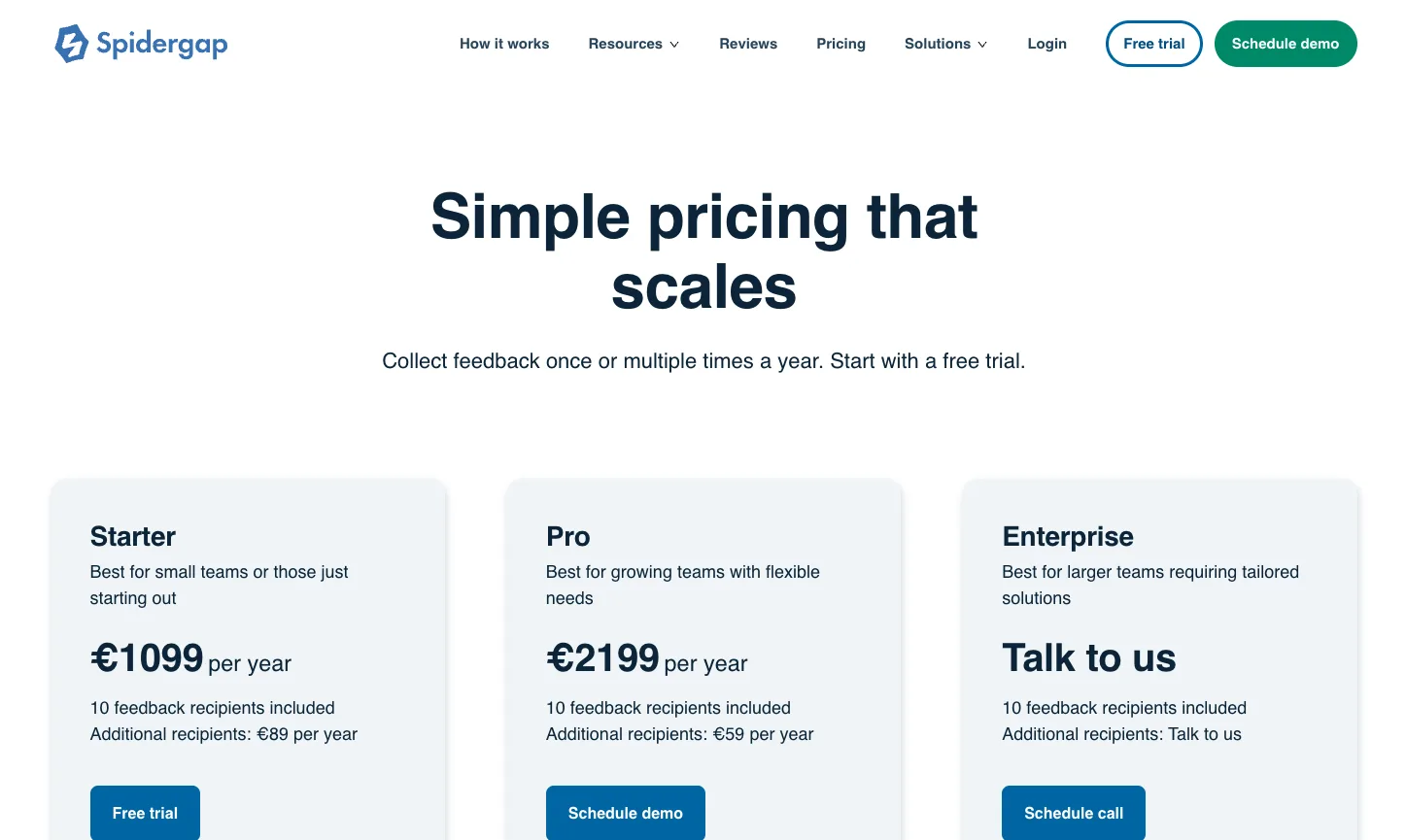
The price is published and the start is free. The Starter plan is $1,099 a year with 10 leaders included, then $89 for each additional leader. You pay only for the people receiving feedback, not for raters or administrators, and your first 360 costs nothing.
The process is simple for everyone. Raters answer through a unique link with no login. Spidergap recommends a step where the leader’s manager or coach approves the rater list first, which catches the leader who only nominated friends.
The report points toward action. Every report includes a personal development plan template. A leader’s license lasts up to 12 months, so a second round within the year costs nothing extra.
Where Spidergap falls short
The debrief is optional and up to you. When the 360 closes, the leader receives a link to a PDF report. You can name a reviewer, usually the manager or a coach, to get a copy, but whether that person is trained is your decision.
Spidergap does 360 feedback and nothing else: no coaching, no succession planning, and no wider talent work. Many buyers pair it with a coach or consultant for the conversation the software does not have, so budget for that person if you do not have one.
Best for
Small teams, consultants, and HR leaders running occasional 360s who want a published price and a fast start, and who already have someone qualified to debrief each leader.
Which 360 feedback tool is right for you?
If your 360 is a research exercise as much as a development one, CCL is the strongest choice. You get the deepest evidence behind the questions and executive comparison groups, provided you have certified facilitators or budget for CCL’s.
Large enterprises already using Korn Ferry’s competency model will get the most from KF360. The value grows with every other Korn Ferry service you buy.
Hogan makes most sense where Hogan personality assessments are already in use. Pairing the two explains why a leader is seen the way they are, as long as a certified partner runs the debrief.
For 360s across hundreds of employees inside the same system as reviews and goals, Culture Amp fits best. Check the confidentiality settings first, and make sure your managers can run the debrief.
Spidergap suits a small team or a consultant who wants to start this week at a published price, with someone qualified lined up to talk each leader through the report.
When the reports keep arriving and nothing changes, the questionnaire is not the problem. LAK Group runs the 360 for you, combining interviews with assessment tools, and its consultants debrief each leader in person. The same firm then coaches the leader, measures again, and brings what it learned into your succession and promotion decisions. To scope a 360 program around the leaders who matter most, book a conversation with LAK Group.
FAQs
What is a 360 feedback tool?
A 360 feedback tool collects ratings and comments about one person from the people around them: their manager, peers, direct reports, and sometimes customers. The person also rates themselves, and the report shows where the two views differ. The debrief, development plan, and any repeat round usually sit outside the tool.
How much do 360 feedback tools cost?
Two of the six publish a 360 price. Spidergap charges $1,099 a year for 10 leaders, then $89 each. CCL charges $380 per leader for Benchmarks for Managers and $425 for executives, plus a facilitator, and certifying your own facilitator costs $2,500 per person. Korn Ferry, Hogan, Culture Amp, and LAK Group quote on request. Compare the all-in cost per leader, including the debrief.
Should you use 360 feedback for performance reviews or hiring?
Two of these providers say no, in writing. Culture Amp states that its 360 is built for development, not performance evaluation. A post on Hogan’s blog states that 360s should not be used as selection tools, citing research on potential bias in rater feedback. Use a 360 to develop leaders, and use validated assessments and structured interviews to hire them.
How many raters does a 360 need, and is the feedback really anonymous?
Culture Amp recommends that each person nominate around six raters. Anonymity depends on the tool’s settings. Culture Amp’s 360 has no minimum reporting size, so a lone rater in a category can be identified, while Spidergap lets you anonymize results. Tell raters before launch exactly who will see their answers.
Do you need a coach to debrief a 360?
You need someone trained, and the leader’s manager is not always the right person. A good debrief picks out the two findings that matter and ends with a plan. CCL and Korn Ferry certify facilitators for this. Culture Amp assigns the manager as Coach, and Spidergap leaves the choice to you. LAK Group’s consultants run the debrief themselves, and the same firm can coach the leader afterward.