
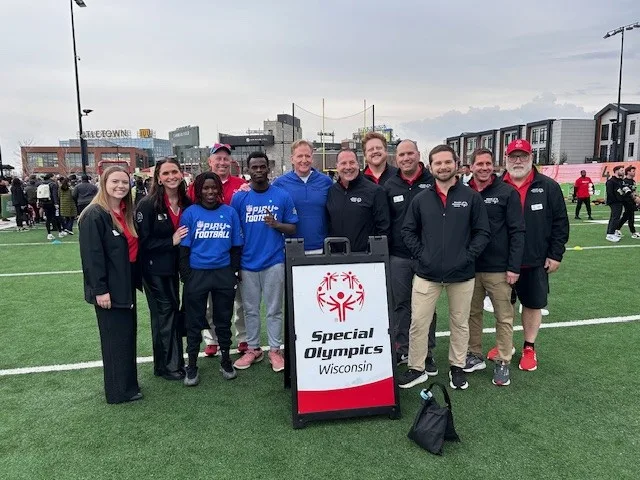
Nine years on the Board of Special Olympics Wisconsin taught me more about leadership than any boardroom I’ve sat in.
By Michael Grubich, CEO, LAK Group
Every year at Summer Games, before the first heat is run, thousands of athletes stand together and recite the same oath:
“Let me win. But if I cannot win, let me be brave in the attempt.”
I have heard it many times. It still stops me.
Read that oath again as a leader. It is not a promise to win. It is a commitment to enter the arena knowing you might not. It is a public declaration that effort, courage, and showing up are the standard and that the outcome, while it matters, does not define your worth.
I have spent my career in executive roles at companies most people in Wisconsin know by name: Aurora Health Care, Jockey International, Kohler Co., and CNH. I have led teams across continents, worked through mergers and acquisitions, integrated cultures that did not want to be integrated, and guided global organizations through situations.
My book, Leadership On Purpose, highlights the many things I have learned about leadership and organizations throughout my 30+ years in a talent and organization development role. However, my nine years on the Board of Directors of Special Olympics Wisconsin provided even more depth and meaning to what true leadership looks like.
I joined thinking I would contribute governance expertise, talent strategy, and executive discipline. I did contribute those things. But I left having learned considerably more than I gave.
The foundation I walked in with
In Leadership ON PURPOSE: How Agile Leaders Inspire Others, the book I co-authored with Shelley Smith, we named the six attributes that form the foundation of excellent leadership:
Followership. Personal Integrity. Learning Agility. Coaching Others. Change Resiliency. Systems Thinking.
I stand behind every one of them. They are research-based, they are observable, and I have watched leaders succeed or fail on them for four decades. Learning agility alone has been shown across meta-analytic research to be one of the more durable predictors of leader success, which is why it anchors how we approach leadership development at LAK Group.
My own hiring and assessment experience sharpened that foundation into four practical differentiators ,the things I look for when the résumés all look the same:
- Humility: the willingness to be wrong out loud, early, before it gets expensive.
- Agility: the capacity to change your mind when the facts change, and your approach when the situation demands a different one.
- Seeking to understand: asking one more question before reaching for the answer.
- Cognitive ability: the horsepower to make sense of ambiguity, hold competing variables in view, and see the pattern before it is obvious.
That was my model. It is a good one. I learned that is was is also incomplete.
There is more to the story
Special Olympics taught me that the foundation is necessary and nowhere near sufficient. The athletes, coaches, families, and volunteers added four qualities I now consider equally load-bearing:
- Genuine curiosity: not the diagnostic kind that is really just gathering ammunition, but the kind that is actually interested in the answer.
- Inclusion and acceptance: starting from the assumption that the person in front of you has something to contribute.
- Patience: the discipline to let people get there rather than doing it for them.
- The courage to be brave in the attempt: competing in public, knowing you may fall short.
Cognitive ability gets you the right analysis. Systems thinking gets you the right plan. Neither one gets you a team that will run through a wall for you on a Tuesday in a bad quarter, a point the research makes bluntly. Judge, Colbert, and Ilies’ meta-analysis of intelligence and leadership found the relationship between raw intelligence and leadership effectiveness to be real but considerably weaker than most executives assume. Smart is table stakes. It is not the differentiator.
Here is what I mean.
Courage is the entry fee, not the reward
In corporate life, we tend to treat courage as something leaders demonstrate occasionally — in a hard conversation, a restructuring announcement, a decision that will not be popular.
Special Olympics athletes treat courage as the price of admission. They compete in front of crowds. They risk falling short in public. They do it anyway, and they do it with a joy that most executives I know have not felt about their own work in years.
Winston Churchill called courage “the foremost of the virtues, for upon it, all others depend.” He was right, and I have never seen it demonstrated more purely than at a Special Olympics competition.
The leadership question this raises: How often do you actually put yourself in a position where you might visibly fall short? If the answer is “rarely,” you are not leading. You are managing risk to your own reputation.
Genuine curiosity outperforms a confident answer
Seeking to understand was already on my list. What I had underrated was the difference between asking questions and being curious.
Most executives are good at the first. We interrogate a business case, stress-test a forecast, probe a hire. But we are usually asking to confirm, not to learn — and people can tell the difference within about ninety seconds.
Spend a day at a Special Olympics event and you will watch coaches and athletes do something else entirely. They ask because they want to know. About your day, your job, your family, whether you’re coming back next year. There is no agenda underneath it. It is disarming, and it builds trust faster than anything I have seen in a leadership development program.
This is the same muscle that drives deep discovery in our work at LAK Group. The presenting problem is almost never the real one. “We have a retention problem” is usually a selection problem, or a manager-capability problem, or a clarity-of-role problem. You only find that by being genuinely interested in the answer instead of arriving with one and by using assessment data that tells you what is actually true rather than what everyone believes is true.
Curiosity is not a soft skill. It is the difference between solving a symptom and solving a business problem.
Patience is a discipline, not a temperament
This is the one that exposed me.
I am wired for pace. Most executives are. We equate speed with competence, and we step in, usually with the best intentions, the moment someone is struggling. It feels like leadership. It is often the opposite.
Watch a Special Olympics coach. They will stand there and let an athlete work through something for as long as it takes, resisting every instinct to shortcut the process. Because the point was never the task. The point was the athlete’s capability after the task.
That is precisely what develops leaders in a business, and precisely what most of us short-circuit. Every time you take the pen back, you have traded a person’s growth for a few hours of your own comfort. Do that enough times and you have built an organization that cannot function without you and then you call it a bench-strength problem.
Patience is not slowness. It is a deliberate investment decision about who owns the capability a year from now.
Coaching Others is one of the six attributes for exactly this reason. It is also why we built Oriel This “Coaching On Demand” platform is scalable, just-in-time access to expert coaches with micro-learning nudges and embedded reinforcement, so a leader gets support in the moment of the challenge rather than three weeks later. Pair it with executive coaching for your senior bench and you get depth and scale at the same time.
Inclusion and acceptance are performance strategies
Special Olympics Wisconsin’s values are Integrity, Teamwork, Inclusion, and Excellence. Note that inclusion and excellence sit side by side. Not in tension. In partnership.
The movement’s vision is that “sport will open hearts and minds towards people with intellectual disabilities and create inclusive communities.” That is not softness. It is strategy and it works, because it starts from the assumption that capability is widely distributed and opportunity is not. Special Olympics now counts more than 4.2 million athletes and Unified partners, 366,000 coaches, and 777,000 volunteers worldwide. That is what happens when you stop screening people out.
The corporate research points the same direction. Google’s Project Aristotle studied 180 teams looking for the ingredients of high performance and found the top factor was not talent density or tenure, it was psychological safety. People perform when they believe they can speak up, try, and fall short without being written off.
Acceptance is the part executives most often get wrong. It does not mean lowering the standard. It means separating the standard from the shape of the person meeting it. The athletes accept each other completely and compete ferociously. Both things, at once.
I carried that lesson directly into M&A work. In every integration I have led, the failure mode was the same: one culture is treated as the “real” one and the other as the acquired inconvenience. Talent walks. Institutional knowledge evaporates. The synergy case quietly dies in the footnotes.
The organizations that get integration right do what Special Olympics does instinctively, they assume the person in front of them has something to contribute, and they build the conditions to find out what it is. That is a culture question before it is a synergy question, and it is measurable: predictively valid talent assessments tell you what a person can actually do, rather than how confidently they interview.
Purpose is an operating system, not a poster
In the early 1960s, Eunice Kennedy Shriver saw how people with intellectual disabilities were being treated. Ther were excluded, institutionalized, underestimated and she did not write a position paper. She opened a summer day camp in her own backyard.
That camp became the first International Special Olympics Games at Soldier Field in Chicago in 1968. Today the movement spans more than 190 countries and millions of athletes.
One woman. One backyard. A refusal to accept the way things were.
Mrs. Shriver’s purpose was never a tagline. It was the decision-making engine. Every choice ran through it: Does this expand dignity and opportunity for these athletes, or doesn’t it?
Most organizations I have worked with have a purpose statement. Very few use it the way she did as the filter that kills good ideas that don’t serve the mission and greenlights hard ones that do.
Purpose that doesn’t change what you say no to isn’t purpose. It’s marketing.
This is Personal Integrity and Systems Thinking operating together at organizational scale: knowing what you stand for, and understanding how one decision ripples through everything else you have built.
Followership is earned. It is never assigned.
I wrote an entire chapter on this in Leadership ON PURPOSE: How Agile Leaders Inspire Others, the book I co-authored with Shelley Smith. Followership is one of the Six Attributes of an Agile Leader, and it is the one that cannot be faked.
Special Olympics proved the point better than any case study I could have written.
Consider who shows up. Coaches who are not paid. Volunteers who take vacation days. Law enforcement officers who run the Torch Run year after year. Families who drive across the state on a Saturday morning. Donors who give without being asked twice.
Not one of them is there because of a title, a bonus, or an org chart.
They are there because the mission is worth their time and because the people leading it have earned their trust. That is followership in its purest form — and it is the same force that determines whether your strategy actually gets executed on Monday morning.
If your people are following you because they report to you, you do not have followership. You have compliance. The two look identical on a good day and nothing alike on a hard one.
This is also why we take executive search and succession planning as seriously as we do. Followership is not something you install after the hire. You select for it.
Humility is knowing exactly when to follow
This may be the hardest lesson, and it is the one I needed the boardroom to teach me.
As Board Chair, my job was not to be the smartest person in the room. It was to make sure the right voice was leading in any given moment, often the athlete leaders, often the staff who lived the work daily, often a fellow board member with expertise I did not have.
Humility and agility converge here. Knowing when to step aside is not a retreat from leadership; it is situational awareness, which is the mark of an agile one. Leaders with genuine followership know when to lead and when to listen.
Bradley Owens and David Hekman’s research on expressed humility found that leaders who acknowledge their own limits and spotlight others’ strengths produce stronger team performance — and that the effect spreads. Humility is contagious in the same way arrogance is. Your team is watching which one you model.
The athletes model this constantly. They compete fiercely and then celebrate the competitor who beat them. Ego management, in real time, in public. Most executive teams I have worked with cannot do it behind a closed door.
What I brought back
Put it together and you get a demanding standard. The foundation from the book, Followership, Personal Integrity, Learning Agility, Coaching Others, Change Resiliency, Systems Thinking. The differentiators from four decades of hiring, humility, agility, seeking to understand, cognitive ability. And what the athletes added, genuine curiosity, inclusion, acceptance, patience, and the courage to be brave in the attempt.
The book gave me the framework. Special Olympics gave me the rest of the story.
That is not a personality profile. It is a set of behaviors, and behaviors can be selected for, measured, coached, and built. We do exactly that for a living and the reason we do it the way we do is the conviction that came off that board with me: people do their best work when they are trusted, when the mission is worth their discretionary effort, and when the person leading them has earned the right to ask.
The business case is not soft, either. Organizations with highly effective talent management strategies achieve 26% higher revenue per employee and 41% lower turnover among high performers. Leadership is not a values exercise. It is a P&L input.
At LAK Group, we are not lifelong consultants, we are business practitioners who have sat in the executive seat, owned the number, and lived with the consequences. We do the deep discovery to find the real issue, not the presenting symptom, and we build solutions your team can own long after we are gone.
To the athletes, coaches, families, volunteers, and staff of Special Olympics Wisconsin: thank you. You taught an executive with four decades of corporate experience what leadership actually looks like.
Let me be brave in the attempt. That is a good standard for a leader, too.
Take the next step
If your leadership team is being asked to deliver through change, an integration, a growth push, a culture that needs to catch up to your strategy. Let’s have a discovery conversation. Not a pitch. A real conversation about what’s actually getting in the way.
Read the book: Leadership ON PURPOSE: How Agile Leaders Inspire Others
Explore further
Build the foundation
- Leadership Development — the six attributes, put into practice
- Executive Coaching — deep, scheduled 1:1 work with certified coaches
- Oriel — just-in-time coaching at scale for mid-level leaders and high-potential talent
- Culture — moving from stated values to lived behavior
- Assessment — data on capability, not confidence
Get the right leaders in the seats
- Spano Pratt Executive Search — executive and nonprofit leadership search
- Executive Recruiting — for-profit and nonprofit
Support people through transition
References and further reading
- Judge, T. A., Colbert, A. E., & Ilies, R. (2004). Intelligence and leadership: A quantitative review and test of theoretical propositions. Journal of Applied Psychology, 89(3), 542–552.
- Owens, B. P., Johnson, M. D., & Mitchell, T. R. Expressed humility in organizations: Implications for performance, teams, and leadership. Organization Science.
- A Meta-Analysis of the Relationship between Learning Agility and Leader Success. Journal of Organizational Psychology.
- Google re:Work. Understand team effectiveness — Project Aristotle.
- Special Olympics International — global movement statistics.
- Special Olympics Wisconsin — mission, values, and Summer Games.
- Grubich, M., & Smith, S. Leadership ON PURPOSE: How Agile Leaders Inspire Others.
Michael Grubich is CEO of LAK Group and co-author of Leadership ON PURPOSE: How Agile Leaders Inspire Others. He served nine years on the Board of Directors of Special Olympics Wisconsin, including one term as Board Chair, and spent four decades in executive roles at Aurora Health Care, Jockey International, Kohler Co., and CNH.